


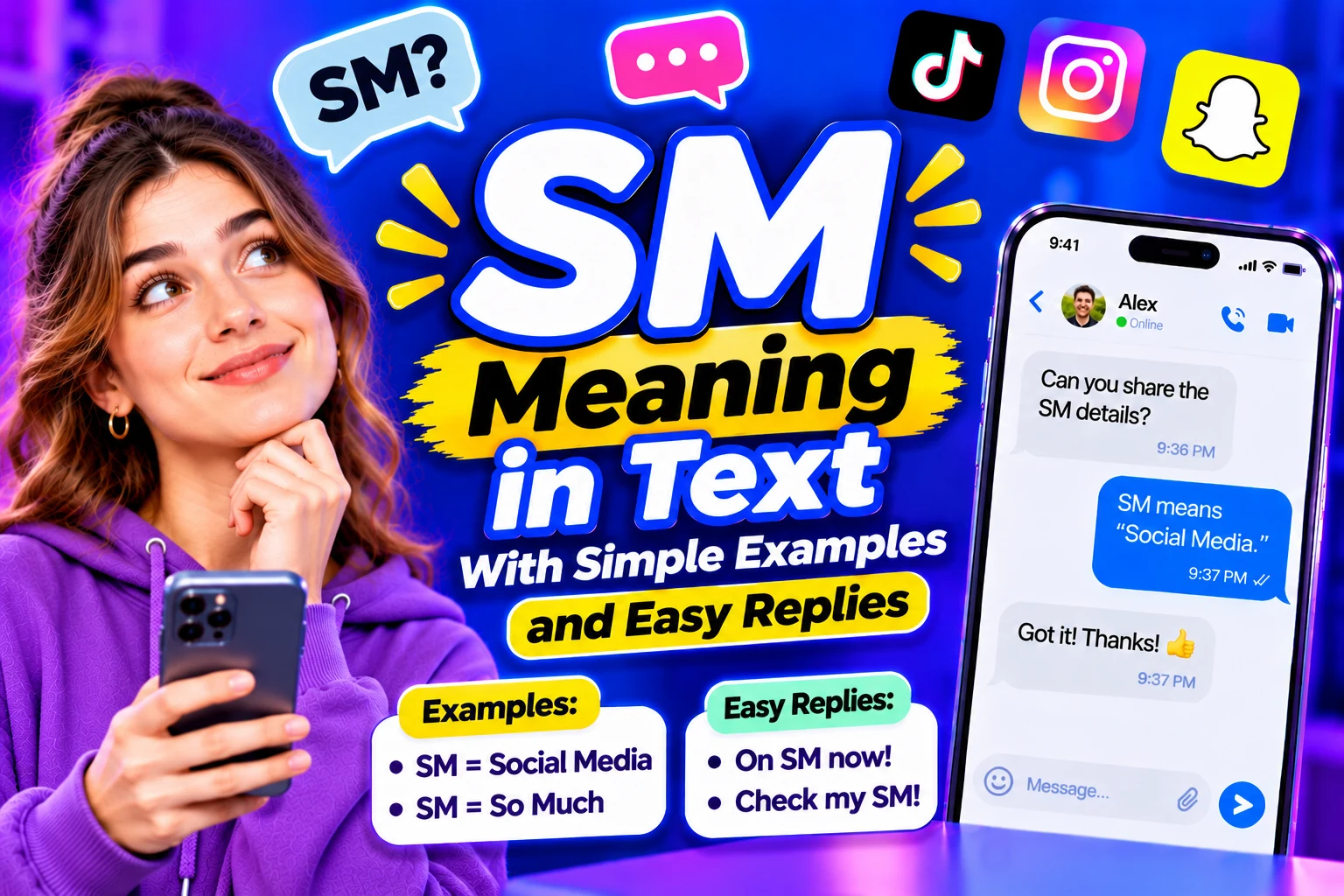
SM means “so much” in casual texting. It makes a message sound stronger. If someone writes, “I needed that laugh sm,” they mean the laugh helped them a lot. You may see it in messages about gratitude, affection, excitement, or frustration.
The letters can also mean “social media” when people discuss online platforms or business accounts. The sentence usually gives you enough clues. “I appreciate you sm” expresses a feeling, while “Check our SM pages” points to social media accounts.
SM Meaning in Text at a Glance
| Where it appears | Meaning | Example |
|---|---|---|
| After a thank-you | So much | “Thank you sm for bringing dinner.” |
| After a feeling | So much | “I love this little garden sm.” |
| In a complaint | So much | “That squeaky chair annoys me sm.” |
| In a marketing discussion | Social media | “The SM calendar needs updating.” |
Think about what the sender is discussing. A personal reaction often points to “so much.” A sentence about posts, campaigns, or account management may use the other meaning.
What Does “So Much” Add to a Sentence?
“So much” adds emphasis to an amount or feeling. Compare “I enjoyed the visit” with “I enjoyed the visit so much.” The second version makes the speaker’s enjoyment clearer. The short form carries that same emphasis in a casual message.
It can also describe how strongly something affects you. “The traffic stressed me out sm” means the traffic caused a lot of stress. In “Your advice helped sm,” the speaker is explaining how useful the advice was.
I’d read the letters as the full phrase first. If “so much” fits naturally into the sentence, you probably have the right meaning. That simple check works for many everyday messages.
Common Messages and What They Mean
“Thank you sm”
This means “thank you so much.” It expresses extra appreciation for something another person did. You might send it after a friend drops off your keys or a classmate shares notes from a lesson you missed.
Amir: I left your charger with the receptionist.
Ella: Thank you sm. My battery was nearly dead.
Ella is grateful because Amir saved her from a small problem. A reply such as “You’re welcome!” or “Glad I could help” would fit naturally.
“I miss you sm”
This means the person misses you a lot. It may come from a partner, a sibling, or a friend who hasn’t seen you recently. The relationship helps explain how affectionate the message feels.
Ruby: Sundays feel strange since you moved. I miss you sm.
Liv: I miss you too. Can we call after lunch?
Ruby is sharing how much she misses their time together. Liv acknowledges the feeling and suggests a way to catch up.
“I love it sm”
This expresses strong enjoyment or approval. Someone might use it after receiving a present, trying a new recipe, or seeing a finished drawing. What they love should be clear from the conversation.
Theo: Here’s the photo frame I made for your desk.
Maya: I love it sm. The little painted flowers are perfect.
Maya adds a specific detail to her reaction. That makes the compliment feel personal and shows what she likes about the gift.
Does It Always Sound Positive?
The tone depends on the words around it. “I enjoyed that show sm” sounds happy. “I worry about this sm” expresses concern. The abbreviation strengthens the thought already in the sentence.
It can also appear in a playful complaint. A friend might write, “You distract me sm 😂” during a study session. The laughing emoji suggests a light tone, while the same sentence during an argument could sound more serious.
Read the exchange before deciding how to respond. If the person seems upset, replying to the concern makes more sense than focusing on the shortcut they used.
What It Means on Different Social Apps
In an Instagram comment, “I like these earrings sm” means the person really likes them. A direct message saying “Your tutorial helped sm” expresses thanks. The post or message being discussed supplies the missing detail.
TikTok
Under a cooking video, “I want to try this sm” shows strong interest in making the dish. Someone who writes “I relate to this sm” feels a close connection to the situation shown. They may have experienced something similar.
Snapchat
A friend might reply to a snap of your old school with “I miss that place sm.” They’re expressing how much they miss it. The picture helps you understand the message even though the reply is short.
The app itself gives you fewer clues than the conversation. Look at the photo, video, or earlier message that prompted the reply.
When Does It Mean “Social Media”?
SM means “social media” in some discussions about digital communication. This use appears in professional and academic material about online platforms. It can also show up in brief team messages about content or account activity.
For example, “Can you send the SM graphics?” may refer to images prepared for social posts. “Who handles SM inquiries?” may ask which person answers messages received through those accounts.
If you’re writing to someone new, spelling out social media makes the request clearer. Once the team understands an abbreviation, it becomes easier to use in shared notes or routine updates.
How to Use the Short Form Correctly
Place it where you would normally put “so much.” That often means after a verb phrase, as in “I appreciate this sm.” In a quick message, the words around it should still make your meaning easy to follow.
| Casual message | Full version |
|---|---|
| “You’ve helped me sm.” | “You’ve helped me so much.” |
| “I enjoyed reading this sm.” | “I enjoyed reading this so much.” |
| “There’s sm noise outside.” | “There’s so much noise outside.” |
For English learners, the difference between so much and so many is also useful. Use “so much” with something you don’t usually count individually, such as noise or homework. Use “so many” with plural things you can count, such as chairs or questions.
For example, “There’s so much homework tonight” and “There are so many questions on this worksheet” are both natural. In schoolwork or formal writing, use the full words.
Similar Shortcuts You May Notice
A few longer abbreviations include “so much” as part of their meaning. Others look similar but express a different thought.
| Short form | Meaning | Purpose |
|---|---|---|
| TYSM | Thank you so much | Shows gratitude |
| IMYSM | I miss you so much | Expresses that you miss someone |
| SMH | Shaking my head | Shows disbelief, frustration, or disapproval |
TYSM already includes the whole thank-you phrase. IMYSM includes “I miss you.” SMH is a separate expression, so reading it as “so much” would change the message.
How to Reply
Respond to the actual thought. If someone thanks you, acknowledge it. If they compliment your work, accept the compliment. If they say they miss you, reply in a way that suits your relationship.
A few simple replies work well.
- “Thanks sm for the lift.” — “Anytime. Glad you got home.”
- “I enjoyed your story sm.” — “Thank you! That means a lot.”
- “I miss our movie nights sm.” — “Same here. Shall we plan one?”
- “That noise bothers me sm.” — “I know. Hopefully they finish soon.”
You can use full words even when the other person uses shortcuts. Choose wording that feels comfortable and keeps the exchange clear.
Frequently Asked Questions
Q: What does “ily sm” mean?
It means “I love you so much.”
Q: Is the abbreviation rude?
The “so much” meaning is ordinary casual shorthand. The surrounding message determines the tone.
Q: Can I use it in a formal email?
Write out the phrase in formal emails so every reader can understand it.
Q: What if “so much” doesn’t fit the sentence?
Check whether “social media” fits, or ask the sender what they mean.
Final Thoughts
SM usually means “so much” in personal chats. It adds emphasis to feelings, reactions, and thank-you messages. In discussions about online accounts, it can mean “social media.” Read the whole sentence and connect the letters to what the person is talking about.
