

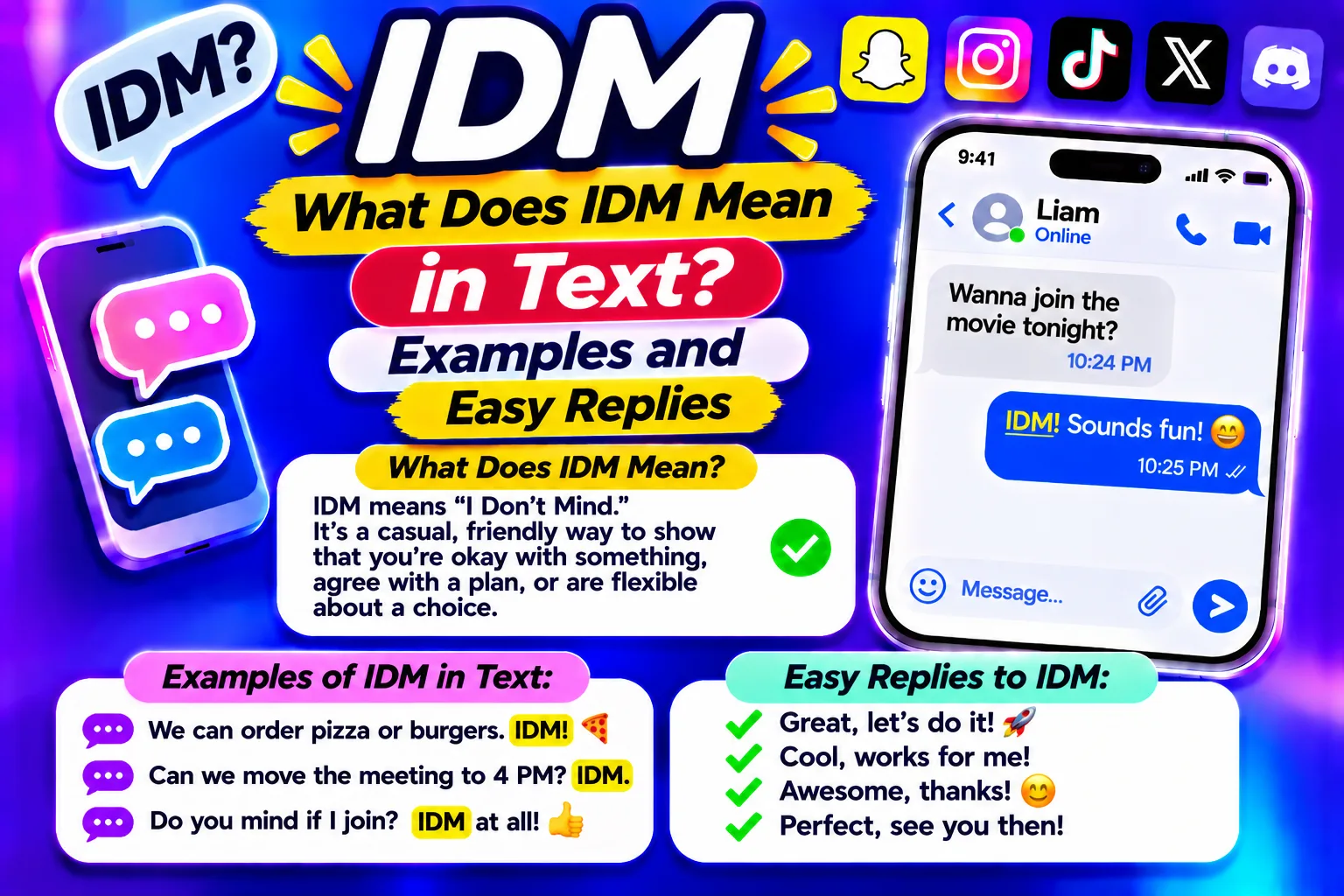
IDM means “I don’t mind” in most texts and social media chats. If a friend asks, “Can we meet at the library instead?” and you reply “idm,” you’re saying the change is fine with you. You can also use it when either choice works or when you’re happy to let someone else decide.
What Does IDM Mean in a Text?
The letters in IDM come from I, don’t, and mind. Here, mind means to object to something or be bothered by it. If you write “idm” after someone suggests taking the later bus, you’re saying that option works for you. The reply can stand on its own, but a few extra words help when there’s a detail the other person needs to know.
| If someone asks… | You can reply… | What your reply tells them |
|---|---|---|
| “Window seat or aisle?” | “idm, you pick.” | Either seat works for you. |
| “Can I use your ruler?” | “idm. It’s in my pencil case.” | They have your permission to use it. |
| “Sorry, I can only stay for an hour.” | “idm, we’ll still have time to catch up.” | The shorter visit is fine with you. |
| “Should we walk or take the bus?” | “idm walking if it’s dry.” | You’re okay with walking under one condition. |
How “I Don’t Mind” Works in Real Conversations
When You’re Happy to Let Someone Choose
IDM is useful when someone has offered you two options and either one will do. You can answer with the shortcut alone. Adding a reason can make the decision easier, especially if the person keeps asking which option you’d prefer.
Zara: Want to try the pottery class on Friday or Saturday?
Aidan: idm, I’m free both days. Pick whichever works for you.
Zara: Saturday, then. I’ll book it now.
Aidan’s reply explains why Zara can go ahead and book. If he can only make Saturday morning, that detail belongs in the message. “idm which day, but Saturday has to be before noon” gives Zara a choice she can actually use.
When Someone Is Asking Permission
“IDM” can also mean “Go ahead” after a question that starts with “Do you mind if I…?” The question asks whether you object. When you say “I don’t mind,” you’re telling the person you’re okay with what they want to do.
Eli: Do you mind if I leave my bike in your garage until Sunday?
Mara: idm. Just leave enough room for the bins.
Eli: Will do. Thanks!
If you’re learning English, pay attention to which question the person asks. “Do you mind if I sit here?” and “Can I sit here?” both ask for permission. “Go ahead” works as a clear reply to either one.
When a Change Is Fine With You
Someone might use IDM to reassure you after a small change. Say your friend can only send a voice note because they’re on a busy train. “idm, I’ll listen when I get home” tells them the voice note is welcome and lets them know when to expect a reply.
What Does IDM Mean on Snapchat and Other Apps?
On Snapchat, IDM usually means “I don’t mind,” just as it does in a text. A friend might ask if they can send you a few more Snaps from a concert. If you reply “idm, send the one with the drum solo,” you sound interested because you’ve asked for something specific.
On Instagram or TikTok, read the comment together with the post or reply above it. If a creator asks whether viewers mind getting a longer tutorial, “idm if it shows every step” means the extra length is fine. In a Discord chat, “idm taking the last turn” tells the group which part you’re willing to do.
Is IDM Rude or Dismissive?
IDM can sound neutral, friendly, or abrupt. If someone asks about the color of a shared folder, a quick “idm” can answer the whole question. If they’ve spent an evening researching places to stay, a little more detail can make your reply feel involved.
Here’s where I’d add a second sentence. “Either place is fine with me. The one near the station would make the trip easier” gives the other person something to work with. You can be flexible and still help them make the decision.
IDM vs. IDC and IDK
These shortcuts are easy to mix up because all three begin with “I don’t.” The last letter changes what the person is telling you. IDM expresses willingness or a lack of preference. IDC means “I don’t care,” and IDK means “I don’t know.”
| Shortcut | Full phrase | Example | What the reply says |
|---|---|---|---|
| IDM | I don’t mind | “idm starting early.” | Starting early is fine with me. |
| IDC | I don’t care | “idc which folder you use.” | I have no interest in which one you pick. |
| IDK | I don’t know | “idk which folder has the final draft.” | I don’t have that information. |
If you’re answering a question about a fact, IDK is the one that fits. “What time does the shop close?” needs a time or a reply like “I’m not sure.” If the question is “Do you mind waiting outside the shop?” then IDM answers it.
What Else Can IDM Stand For?
Some people use IDM for “It doesn’t matter.” That reading can fit when someone is saying a small detail won’t affect the outcome. “idm which envelope you use” could work with either phrase, and the practical answer is the same. Use whichever envelope is handy.
Two other meanings show up when the topic changes:
- Intelligent dance music. In a playlist title or an album discussion, IDM can name a style of experimental electronic music.
- Internet Download Manager. In a chat about browser extensions or file downloads, IDM can refer to software for managing downloads.
How to Reply When Someone Says IDM
If the person is leaving a decision to you, make it and confirm the details. For instance, if they say “idm” when you offer two meeting times, reply “Let’s do 4:30. I’ll meet you by the front desk.” That takes care of the choice and tells them where to go.
If you’ve asked permission, a quick thanks usually works. When their reply includes a condition, acknowledge it. “Thanks. I’ll bring it back before lunch” confirms that you understood the part that mattered.
Frequently Asked Questions
Q: Is “idm” the same as “IDM”?
Yes. In casual chat, uppercase and lowercase can both mean “I don’t mind.” Read the nearby words if the conversation is about music or software.
Q: Does IDM sound flirty?
It can appear in a flirty chat. If someone says “idm seeing you again,” the interest comes through in “seeing you again.”
Q: Can I use IDM in a work message?
In an informal team chat, it may work if your coworkers know the shortcut. “Either time works for me” is clear in an email or a message to a client.
Q: Should I write “I don’t mind waiting” or “I don’t mind to wait”?
Write “I don’t mind waiting.” When an action directly follows mind, use its -ing form.
Final Thoughts
Read IDM as “I don’t mind” when someone is responding to a choice, a request, or a change of plans. If you’re the one sending it, add any detail that affects what happens next. “idm, as long as we leave by eight” is short and gives the other person a useful answer.
