


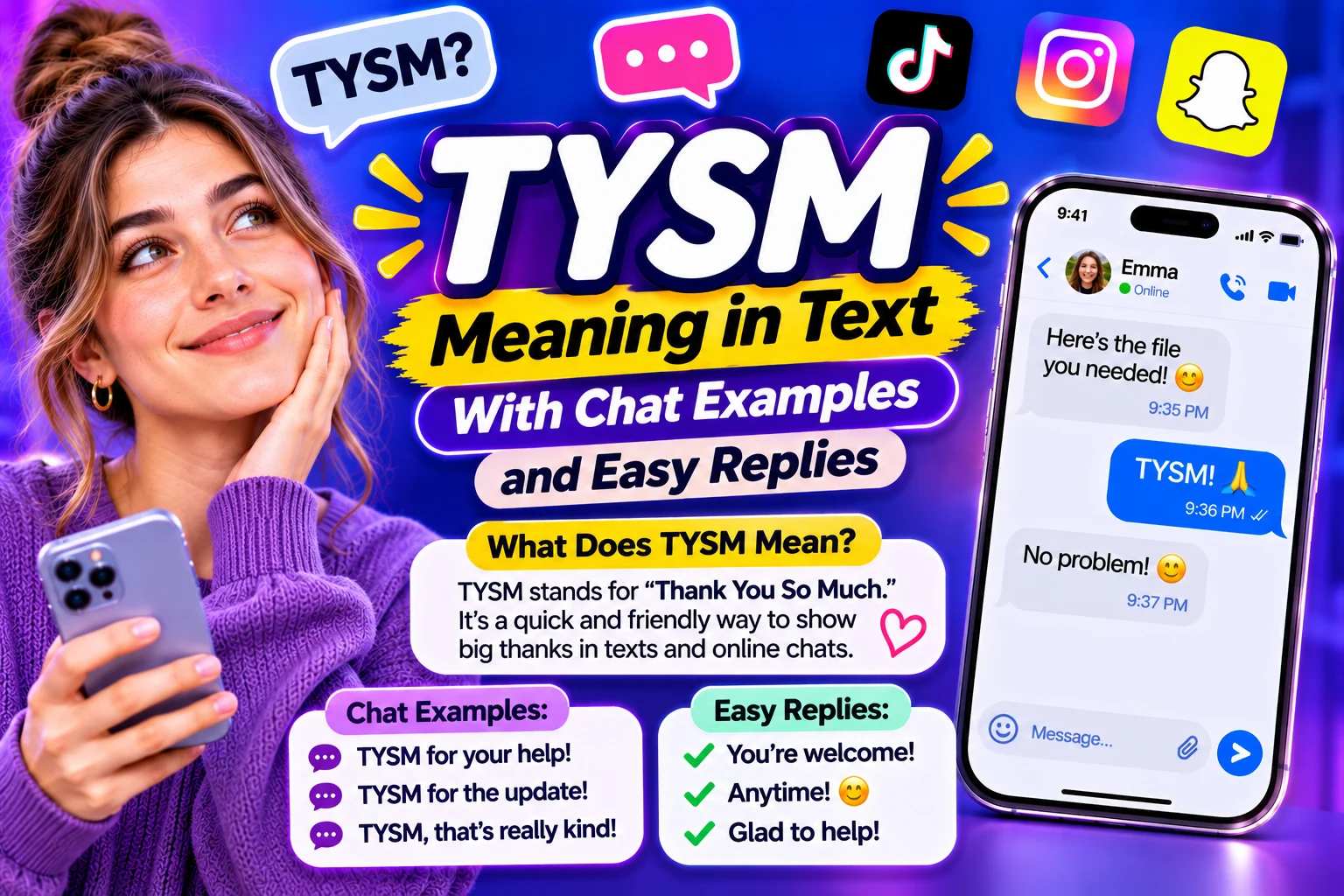
TYSM means “thank you so much” in a text. It’s a casual way to show how much you appreciate something. If a friend saves you the last seat at a busy café, you might reply, “TYSM! I’ll be there in five.”
You can send the four letters on their own when the reason is clear. If you want the message to feel more personal, add what you’re thankful for. “Tysm for waiting with me” tells someone exactly what made a difference.
TYSM Meaning in Text and How It’s Used
Each letter comes from the start of a word. T stands for thank, Y for you, S for so, and M for much. You’ll see both TYSM and tysm in informal messages. Either spelling carries the same basic meaning.
The phrase works best when it connects to something that just happened. Maybe a friend sent you directions when you were lost. A quick “tysm, found it!” shows your appreciation and lets them know you arrived. That extra detail can be more helpful than a thank-you by itself.
How It Sounds in Real Chats
When a friend makes your day easier
Sana — “I put your lunch in the fridge so you can grab it after class.”
Eli — “Tysm! I forgot to pack anything this morning.”
Eli is grateful for a small favor that came at the right time. The second sentence explains why it mattered. Between friends, that’s enough to make a short message feel thoughtful.
When someone gives you useful feedback
Drew — “Your slides look good. I’d move the price to the first slide so people see it sooner.”
Mina — “Tysm for catching that. I’ll move it before we present.”
Mina thanks Drew for a specific suggestion and says what she’ll do with it. This kind of reply fits a relaxed chat between classmates or teammates. In an email to a new client, “Thank you for pointing that out” would read more clearly.
When a message gives you some encouragement
Leah — “You handled that interview question well. Your example made the answer easy to follow.”
Jay — “Tysm. I was worried I’d talked for too long.”
Here, Jay is responding to encouragement. The thank-you leads into something more personal because the comment addressed a worry he already had. If he wanted to keep the reply short, “Tysm, I needed to hear that” would also fit.
Where You’ll See It Online
In comments and direct messages
A creator might reply “tysm!” when someone compliments their work. For instance, under a photo of a handmade bag, a reader could ask where the fabric came from. After getting an answer, they might write, “Tysm! I’ve been looking for that print.” The exchange makes it clear that they’re thanking the creator for the information.
In a private message, you have room to say a little more. If someone shares your artwork, “Tysm for sharing my drawing. That was kind of you” gives them a more personal reply. In a public comment, a quick thank-you often makes sense because readers can see what happened just above it.
In group chats and games
In a group chat, “tysm everyone” can thank several people at once. You might send it after friends help you settle on a gift. If one person did a specific part, name it so they know you noticed. “Tysm for picking it up, Dani” tells the group exactly what you’re thanking Dani for.
A game chat may call for a faster response. If a teammate gives you an item you need, “tysm” can be enough while the match is still going. Afterward, “Thanks for dropping that shield” lets them know which move helped.
How to Reply to TYSM
“You’re welcome,” “Anytime,” and “Glad I could help” all work. I’d choose a reply that fits what happened. If you shared a file, you can simply say “No problem.” If the person was nervous about something, “Glad it helped. Hope it goes well” gives them a little encouragement.
| If someone sends | You can reply |
|---|---|
| “Tysm for sending the recipe.” | “Of course! Let me know how it turns out.” |
| “TYSM! The address was right.” | “Glad you found it.” |
| “Tysm for checking in.” | “Anytime. I’m here if you want to talk.” |
| “Tysm for telling me the deadline moved.” | “No problem. We’ve got until Monday now.” |
Sometimes the thank-you is the last message the chat needs. If you sent a link and the person replied “tysm,” you can leave the exchange there. A reply makes more sense when you have something to add or want to acknowledge a personal message.
TYSM vs. TY and THX
TY means “thank you,” and THX means “thanks.” Both give you a quick way to show appreciation. TYSM adds “so much,” which gives the thank-you more emphasis. For example, “TY for the reminder” fits a quick update, while “TYSM for staying late to help me finish” puts more weight on the favor.
The shorter forms can still sound warm. “Thanks for walking me to the station. I felt a lot better having company” gives the reader more than a longer abbreviation could. If you want your gratitude to feel personal, the detail you add often matters more than the number of letters you type.
When to Spell Out the Full Phrase
Use the shortcut when the conversation is casual and the reader is likely to understand it. A close coworker who sends you a meeting link might be fine with “tysm.” If you’re writing to a teacher, a customer, or someone you’ve just met, “Thank you so much” is easier to read.
For a more formal message, you can thank the person for the exact thing they did. “Thank you for reviewing my application” works in an email. “I appreciate you taking the time to explain the changes” fits when someone has given detailed feedback. Both phrases tell the reader why you’re writing.
How to Read the Tone
The abbreviation usually reads as a friendly thank-you. An exclamation mark can add excitement, while lowercase can feel relaxed. Even so, the rest of the exchange is a better clue than the spelling. “Tysm for remembering my birthday” sounds warm because you know what the person appreciates.
It can also be sarcastic if the sentence makes that clear. Imagine a friend joking, “Tysm for eating the last slice before I got home.” The humor comes from thanking someone for doing the opposite of what they wanted. If the text only says “tysm,” I’d read it as sincere unless the earlier messages suggest otherwise.
Frequently Asked Questions
Q: What does “tysm for the follow” mean?
It means someone is thanking you for following their account.
Q: Is it okay to send the letters on their own?
Yes. It works as a complete reply when the person knows what you’re thanking them for.
Q: Does “tysm ❤️” mean someone is flirting?
The heart adds warmth. Whether it feels flirty depends on the rest of the conversation.
Q: Can I write “thank you tysm”?
Choose “tysm” or “thank you so much” because the shortcut already includes “thank you.”
Final Thoughts
If someone thanks you with TYSM, answer as you would if they’d written “thank you so much.” If you’re the one sending it, a few extra words can show why you appreciated the favor. “Tysm for saving me a seat” does both in one line.
