


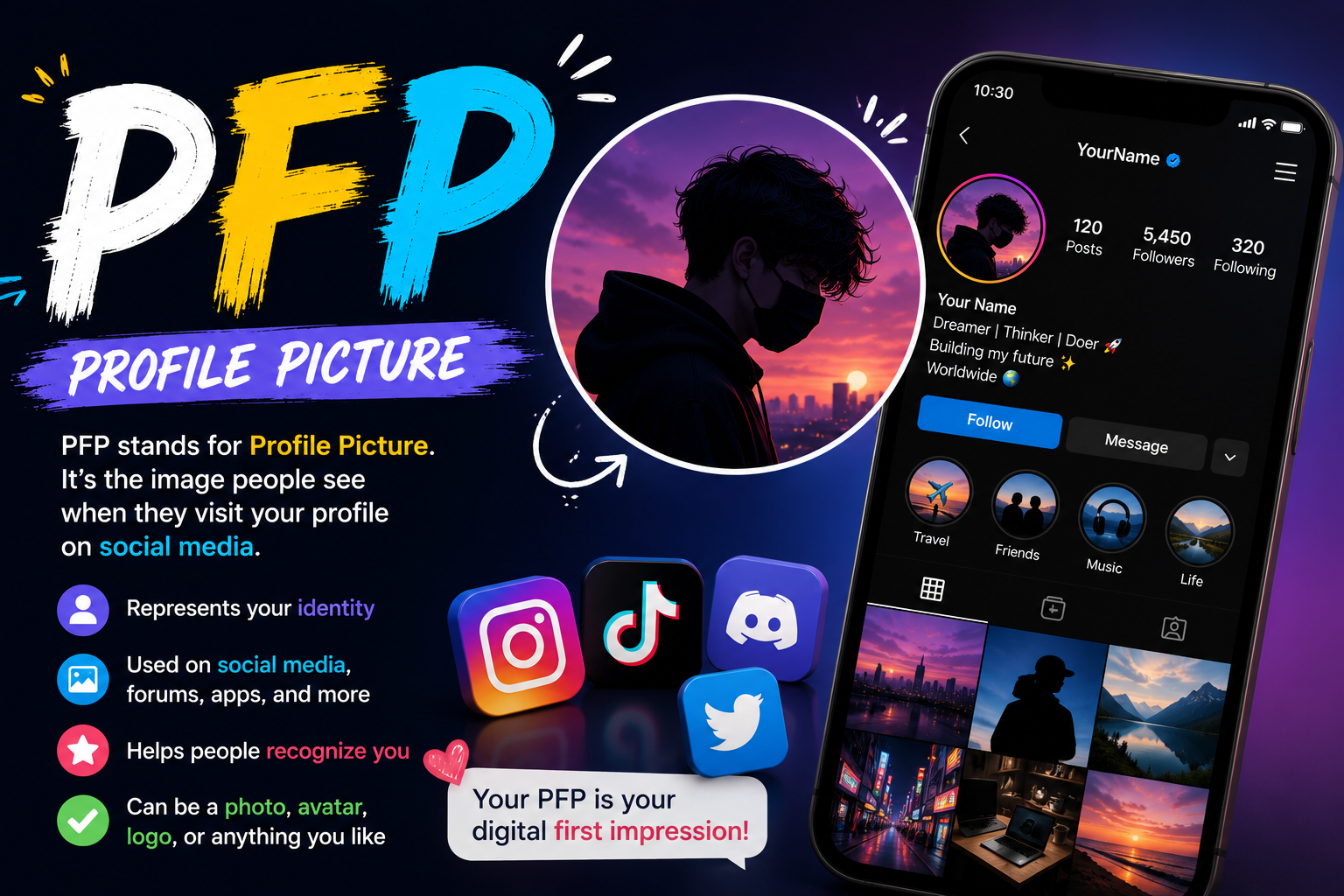
What Does PFP Mean?
Someone commented “nice pfp” on your latest post and you want to make sure you’re reading it right. PFP stands for “profile picture.” That’s the whole definition. It’s the image tied to your account on any app or platform, whether that’s a real photo, a cartoon, a meme, or an AI-generated avatar.
People use it constantly because typing “profile picture” over and over gets tedious. PFP is shorter, faster, and instantly understood across nearly every platform where accounts and avatars exist.
Where Did PFP Come From?
Early Origins
Long before PFP caught on, older platforms had their own shorthand for the same idea. Early social networks and messengers like AIM and MSN Messenger used the term “display picture,” and that habit carried over into places like WhatsApp, where DP is still the more common term in parts of South Asia and the UK. Around the same era, MySpace and early Facebook users mostly said “profile pic” in full.
How It Moved Into Mainstream Slang
As texting culture sped up and phone keyboards made every extra keystroke annoying, “profile picture” got trimmed down to PFP. Gaming communities and forums, especially around platforms like Discord and Steam, picked it up early since avatars were a constant topic of conversation there. From gaming chats, it spread outward into everyday texting and social media captions, and by the 2020s it had become standard shorthand recognized by Gen Z and younger Millennials across nearly every platform.
How People Use PFP Today
On Social Media
You’ll see PFP show up in comments, captions, and casual chatter about someone’s account. A comment like “your pfp is fire” is just a compliment on the current picture, nothing more.
In Gaming and Chat Platforms
Discord and gaming communities lean on PFP heavily, since avatars there often say more about someone’s personality than their username does. Anime characters, custom art, and game screenshots are all common choices, and regulars in a server tend to recognize each other by their PFP before they even read the name attached.
As a Signal of Identity or Mood
People read a lot into PFP choices, sometimes more than the picture actually intends. A cartoon avatar might suggest someone’s into a certain fandom, a real photo can read as more personal or trustworthy, and a blank or default image sometimes gets treated with mild suspicion in comment sections. None of this is an official rule, just a pattern that’s developed around how people size each other up online.
Is PFP Rude or Confusing to Use?
It’s Neutral, Not Rude
PFP itself carries no attitude. Whether a comment about your PFP feels like a compliment, a joke, or an insult depends entirely on the tone surrounding it, not the abbreviation itself.
Occasional Alternate Meanings
Outside of texting and social media, PFP can mean something else entirely. In finance and business contexts, it sometimes stands for “Personal Financial Plan” or “Paid For Performance.” These meanings almost never show up in casual chat, so in a text conversation or online comment, assume profile picture unless the topic clearly points somewhere else.
How to Use PFP in a Sentence
A few natural examples of how it shows up in real conversation:
- “Can you update your pfp? It’s still your old headshot.”
- “Everyone in the group chat changed their pfp to that same meme.”
- “Nice pfp, when did you get that photo taken?”
When Not to Use It
Keep it out of professional emails, résumés, or formal communication. Writing “please update your PFP” in a company-wide message will just come across as out of place. “Profile picture” or “profile photo” is the safer choice in any setting where casual slang doesn’t quite fit.
PFP vs. Similar Terms
PFP overlaps with a few related words, and it helps to know how they differ. DP (display picture) means the same thing but leans more common in South Asia and on WhatsApp. Avatar is broader and often implies something animated or game-related rather than a real photo. Icon is an older, more general internet term that’s mostly been replaced by PFP in everyday texting.
Frequently Asked Questions
Does PFP always mean profile picture? In texting, chats, and social media, yes, almost without exception. Outside those settings, in finance or business contexts, it can occasionally mean something unrelated, but that’s rare in casual conversation.
Is PFP the same as DP? Functionally, yes. Both refer to the image tied to your account. DP is the older term and more common in certain regions, while PFP has become the dominant version among younger, global internet users.
Can a PFP be anything other than a real photo? Definitely. Drawings, memes, AI-generated images, game characters, and Bitmojis all count as PFPs. The term just refers to whatever image represents you, not a specific style of photo.
Is it okay to ask someone about their PFP? Yes, it’s a normal, low-stakes thing to comment on. “Nice pfp” or “who’s that in your pfp” are both common, friendly questions online.
Final Thoughts on PFP
PFP earns its spot in everyday internet language because it does exactly what good slang should: says a lot with very little. Whether it’s a compliment, a nudge to update an old photo, or just a passing comment in a group chat, those three letters keep things quick and casual. Just remember to spell it out in anything formal, and you’ll never misuse it.
