


A teammate walks straight past the hidden treasure, and someone replies, “kek.” Nobody explains the joke because everyone else seems to understand it. If the word is new to you, the reaction can look confusing.
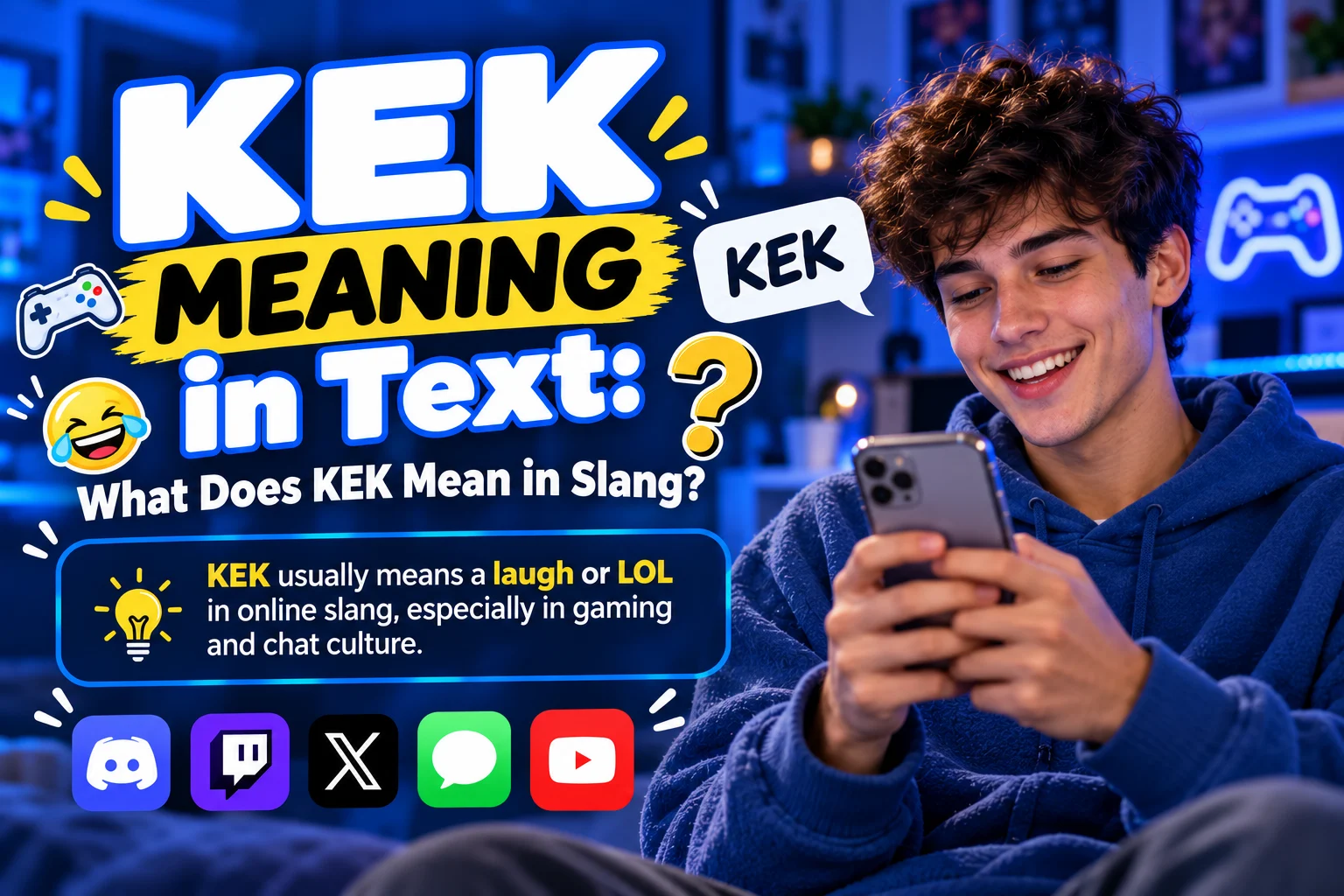
KEK usually expresses laughter, much like “LOL” or “haha.” It has strong links to gaming culture and can sound playful, sarcastic, or teasing. The message before it helps you understand what the person finds funny.
What Does KEK Mean in Text?
The KEK meaning in text is generally laughter or amusement. Someone might send it after a joke, an unexpected mistake, or a ridiculous situation.
Dictionary.com describes KEK as an online expression similar to LOL or haha, used especially by gamers. It is not a separate phrase you need to translate letter by letter.
For example, “I brought my laptop but forgot the charger” might receive “kek.” The sender is reacting to the situation with amusement.
| Message | Likely meaning |
|---|---|
| “kek, that timing was perfect.” | That was funny. |
| “You opened the wrong chest, kek.” | Playful laughter about a mistake |
| “Kek, another brilliant plan.” | Possibly sarcastic amusement |
| “That caption got me. Kek.” | The caption made the sender laugh |
Does KEK Stand for Anything?
KEK does not have a standard full form in its laughter use. Unlike LOL, its letters do not represent the initials of an English phrase.
You may see it explained as “LOL in Orcish.” That description refers to its World of Warcraft connection.
It does not mean KEK expands to “laughing out loud” letter by letter. Instead, the word serves a similar purpose in conversation.
Where Did KEK Come From?
KEK has connections to Korean online laughter and gaming communities. Slang.net discusses both its Korean laughter use and its World of Warcraft association.
Those connections help explain why it appears naturally among some gamers while remaining unfamiliar to other people.
You do not need to know the history to understand a funny reply. However, the background explains why KEK feels different from an ordinary “haha.”
The World of Warcraft Connection
In World of Warcraft’s familiar faction-language example, a Horde player’s “lol” appears as “kek” to Alliance players. The game’s language filter changes what the opposing side sees.
Players began using the result deliberately as a laughter expression. Slang.net records this connection in its KEK entry.
That does not mean KEK only works inside the game. Someone familiar with the expression can use it in an ordinary group message.
The Korean Laughter Connection
Forms such as “keke” and “kekeke” are associated with typed laughter in gaming culture. They connect with Korean laughter represented using repeated characters such as “ㅋㅋㅋ.”
KEK can therefore carry that laughter association as well. Avoid describing it as a literal Korean translation of every use of “LOL.”
The practical meaning remains simple: someone is expressing amusement. The historical connections explain how that expression became recognizable.
What Does KEK Mean in Gaming?
In gaming chat, KEK usually reacts to something funny during a match. That could be an accidental fall, a failed escape, or an unexpected outcome.
For example, a player celebrates too early and immediately loses the round. A teammate might respond with “kek.”
Whether that feels friendly depends on the group. Friends sharing a joke differs from strangers repeatedly laughing at someone’s mistakes.
A Gaming Conversation Example
Player one: “I spent five minutes protecting the wrong doorway.”
Player two: “Kek, the objective was upstairs.”
The second player finds the mistake funny. Nothing in KEK itself tells you whether the teasing is welcome.
If the first player is already frustrated, a more helpful reply might fit better. Shared humour still depends on the people involved.
Is KEK the Same as LOL?
KEK and LOL can both express amusement, but they are not identical in every setting. KEK often signals familiarity with gaming or meme culture.
LOL is an abbreviation of “laughing out loud.” KEK works as an alternative laughter expression without that same letter-by-letter structure.
Neither one measures how loudly someone actually laughed. A brief response may simply acknowledge that something was amusing.
| Expression | Basic use | Useful distinction |
|---|---|---|
| KEK | Laughter or amusement | Associated with gaming and memes |
| LOL | Laughing out loud | A familiar abbreviation |
| Haha | Written laughter | Easy to understand without gaming knowledge |
| Hehe | Written laughter | May suggest a chuckle or playful reaction |
Is KEK Sarcastic?
KEK can be sarcastic, but it does not always signal sarcasm. A genuinely funny story can receive the same response.
Compare “kek, your dog stole the cushion again” with “kek, what a reliable service” after another cancellation. The second example suggests criticism.
Look at what the person is reacting to. The full statement gives you more information than the laughter word alone.
Does KEK Mean Someone Is Laughing at You?
It might, especially if your mistake is the subject of the conversation. However, that does not automatically make the reaction hostile.
A friend can laugh with you about an awkward moment. Someone else could use the same expression to mock you.
My advice is to consider the wider pattern. If the jokes feel uncomfortable, say so rather than trying to decode every short reply.
KEK on Discord, TikTok, and Instagram
On Discord, KEK can appear in gaming discussions, meme channels, or casual chats. Its basic laughter meaning does not require a separate Discord definition.
On TikTok or Instagram, it may react to a funny clip or comment. For example, “kek, I watched that twice” expresses amusement.
The platform alone does not establish the tone. A supportive friend and a hostile commenter can use the same word differently.
What Does Top Kek Mean?
“Top kek” is a related meme expression for something particularly amusing or ridiculous. Dictionary.com discusses it as an extension of KEK’s humour-related use.
For example, someone might use it after a surprisingly accurate joke about their gaming group. It can also carry an ironic tone.
You do not need to treat it as a formal ranking of humour. It is another informal reaction whose meaning depends on the exchange.
Is KEK Offensive or Political?
KEK’s gaming laughter meaning is not automatically offensive. However, the term also acquired associations with far-right meme communities.
Dictionary.com documents that later appropriation, including references to “Kekistan.” Those associations matter when the word appears alongside related political imagery or slogans.
A simple “kek” after a gaming joke does not establish someone’s political beliefs. Read the surrounding content before making that judgment.
How Should You Reply to KEK?
Usually, you can continue the conversation without sending a special response. If someone found your story funny, add another detail or acknowledge the joke.
You can also ask what they mean if the context feels unclear. Understanding a word does not always reveal someone’s intention.
| Situation | Possible reply |
|---|---|
| A friend laughs at your harmless mistake | “I realized it about ten seconds later.” |
| Someone enjoys your joke | “Glad someone appreciated that one.” |
| You are unsure what amused them | “Which part are you laughing at?” |
| The teasing bothers you | “I’d rather you didn’t joke about that.” |
| You do not recognize the term | “Does kek mean haha here?” |
When Should You Avoid Using KEK?
Choose clearer wording when your audience may not recognize gaming slang. “That made me laugh” works without requiring an explanation.
Avoid laughter replies when someone is sharing a serious problem. A message about disappointment may need acknowledgment rather than a joke.
You also do not need to adopt KEK just because others use it. “Haha” or a written response may suit your usual voice better.
Frequently Asked Questions
What does KEK mean in text?
KEK usually expresses laughter or amusement, similar to LOL or haha.
Is KEK an acronym?
No, its laughter use does not have a standard English expansion.
What does KEK mean in World of Warcraft?
It is associated with Horde players’ “lol” appearing as “kek” to Alliance players through the language filter.
Is KEK always sarcastic?
No, it can express genuine amusement as well as sarcasm or teasing.
Does KEK automatically have a political meaning?
No, although it has political associations in certain meme contexts.
Can I use KEK outside gaming?
Yes, but the other person may understand a more familiar expression such as “haha” more easily.
