


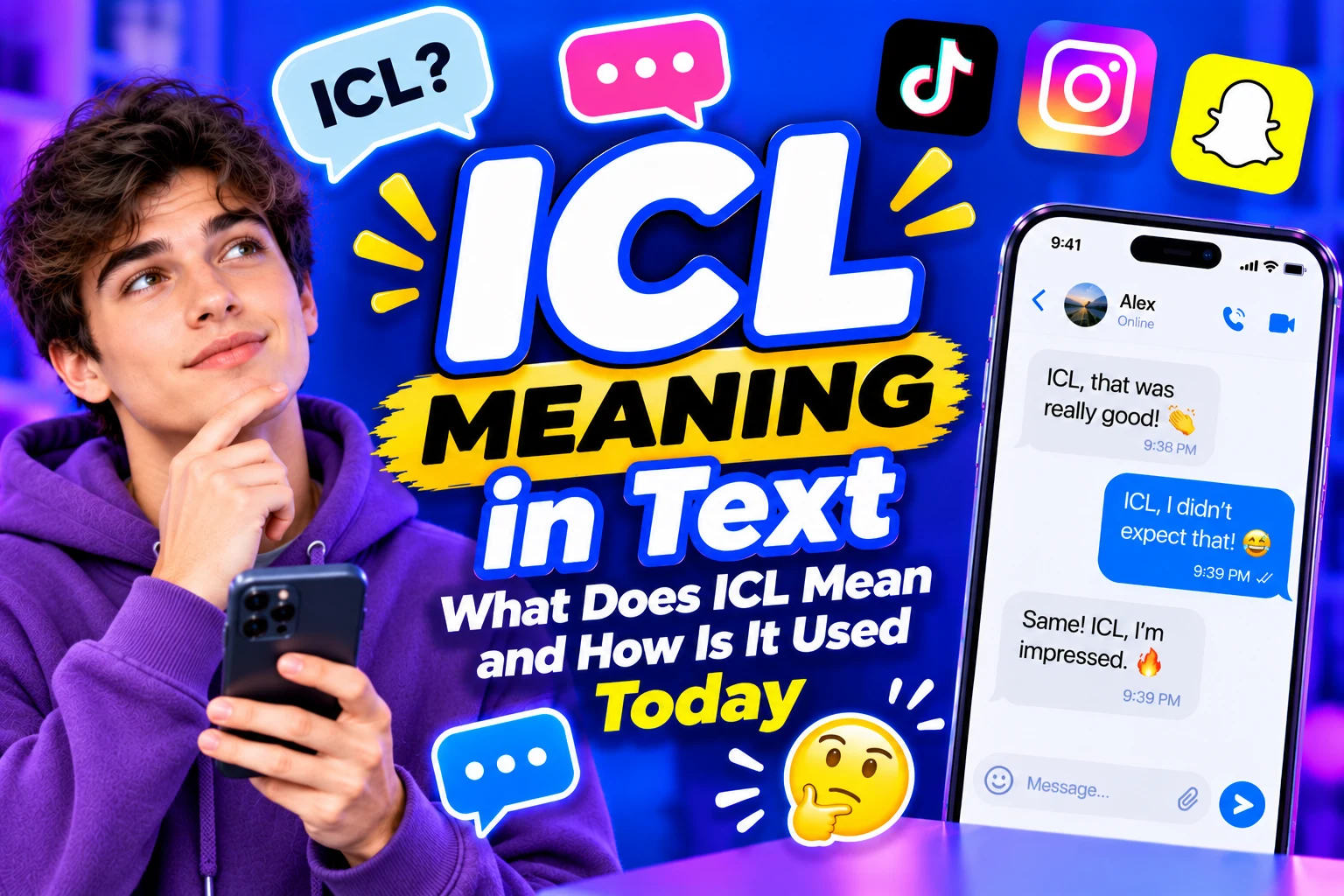
ICL means “I can’t lie” in texting and internet slang. It introduces an honest opinion, admission, or reaction. For example, “ICL, I enjoyed the school reunion” means “Honestly, I enjoyed the school reunion.”
The phrase usually adds emphasis rather than changing the message itself. Someone might use it before praising your cooking, admitting a mistake, or sharing an unpopular opinion. The words that follow reveal whether the message feels warm, awkward, or critical.
ICL Meaning in Text: A Quick Breakdown
ICL takes its letters from “I can’t lie.” In casual messages, it often works like “honestly” or “to be honest.”
The expression does not usually mean the person is literally unable to tell a lie. Instead, they are presenting the next statement as their honest view.
| Part | Word |
|---|---|
| I | I |
| C | Can’t |
| L | Lie |
For instance, “ICL, I preferred the smaller apartment” tells you what the speaker really thinks. It may introduce a view they expect others to disagree with.
What Does “I Can’t Lie” Add to a Message?
ICL draws attention to the speaker’s sincerity. It can make a statement sound more open or personal.
Compare these messages:
“The homemade bread was excellent.”
“ICL, the homemade bread was excellent.”
Both praise the bread. The second makes the praise feel like a candid admission, perhaps after the speaker expected something less impressive.
However, adding ICL does not prove that a statement is truthful. It shows how the writer wants to present their opinion.
How People Use ICL in Conversations
ICL fits several kinds of informal exchanges. Its meaning stays consistent while the purpose changes.
Giving Unexpected Praise
A: “You thought my old camera was useless.”
B: “ICL, those photographs turned out beautifully.”
The second person admits that the results changed their expectations. The praise may feel stronger because it acknowledges an earlier doubt.
Admitting a Small Mistake
A: “Why did you take the stairs?”
B: “ICL, I didn’t notice the lift.”
Here, ICL introduces a slightly embarrassing admission. It keeps the explanation casual.
Sharing a Preference
A: “Everyone wants to watch the final indoors.”
B: “ICL, I’d rather listen on the radio outside.”
The speaker gives their genuine preference. They are not necessarily asking everyone else to change plans.
Expressing a Feeling
A: “Are you ready to move?”
B: “ICL, leaving this neighborhood feels strange.”
The abbreviation makes room for an honest feeling. The message could express sadness, uncertainty, or mixed emotions.
Where Should ICL Go in a Sentence?
ICL commonly appears at the beginning or end of an informal statement. Putting it first introduces the opinion. Putting it last adds a final note of honesty.
Both of these sample messages work:
- “ICL, the second half was more interesting.”
- “The second half was more interesting, icl.”
A comma helps separate the abbreviation from the main statement. Casual texters may leave punctuation out, but including it can improve readability.
Avoid dropping ICL between words that belong together. “The second ICL half was interesting” interrupts the sentence and makes the message harder to follow.
Is ICL Positive or Negative?
ICL can introduce positive, negative, or neutral statements. The abbreviation itself does not decide the mood.
| Example | Likely purpose |
|---|---|
| “ICL, your instructions were easy to follow.” | Praise |
| “ICL, the queue put me off.” | Complaint |
| “ICL, I usually eat breakfast late.” | Personal information |
| “ICL, I expected a different result.” | Surprise or disappointment |
| “ICL, I owe you an apology.” | Acknowledgment |
Read the full sentence before deciding how to respond. An honest admission and an insult may begin with the same letters.
Does ICL Sound Rude?
ICL is not rude by itself. However, it can make criticism sound especially direct.
“ICL, your idea makes no sense” may feel dismissive. The honesty marker does not soften the judgment.
A more useful version would be, “ICL, I’m struggling to understand the last step.” That identifies the problem and gives the other person something specific to explain.
I suggest checking the statement after ICL. If those words sound unkind without the abbreviation, adding it will not fix them.
ICL vs. NGL: What Is the Difference?
ICL means “I can’t lie,” while NGL means “not gonna lie.” Both can introduce an honest opinion or admission, so their conversational roles often overlap.
Consider these examples:
“ICL, I missed having a quiet weekend.”
“NGL, I missed having a quiet weekend.”
The basic message stays the same. The choice often reflects the writer’s familiar texting style rather than a major difference in meaning.
Do not treat one as automatically more sincere. Neither abbreviation measures how honest someone is.
ICL vs. TBH and FR
These expressions can appear in similar conversations, but they emphasize different things.
| Expression | Full meaning | Typical use |
|---|---|---|
| ICL | I can’t lie | Introducing a candid statement |
| NGL | Not gonna lie | Admitting an opinion or feeling |
| TBH | To be honest | Framing an honest assessment |
| FR | For real | Emphasizing seriousness or agreement |
For example, “ICL, that was difficult” introduces an admission. A reply of “FR” can agree that it was genuinely difficult.
FR does not always replace ICL naturally. Choose the expression according to what the sentence needs.
What Does ICL Mean on TikTok or Snapchat?
In an ordinary slang comment or message, ICL still means “I can’t lie.” The app does not automatically give it another expansion.
A viewer might comment, “ICL, I watched the ending twice.” They are admitting something about their reaction.
In a private Snapchat exchange, “ICL, I need a quieter evening” could communicate a personal preference. The platform changes where the message appears, while the sentence explains its purpose.
Is ICL Mainly British Slang?
ICL is especially associated with British internet slang, though people elsewhere also use it. It is not restricted to British users or British conversations.
For a global audience, the important point is familiarity. Some readers will recognize the letters immediately, while others will need the full phrase.
There is no need to copy someone’s regional style to use the expression. Choose wording that feels comfortable and clear in your own conversation.
Is ICL Suitable for Formal Writing?
ICL belongs in informal communication. It can fit a relaxed exchange with friends, but a formal email usually benefits from clearer wording.
Instead of writing, “ICL, the delivery schedule worries me,” explain the concern directly:
“The delivery schedule leaves limited time for testing.”
The revised sentence tells the reader why the issue matters. In an assignment, application, or client message, that detail is usually more useful than a slang introduction.
How Do You Reply to ICL?
Respond to the statement that follows the abbreviation. You do not need a special reply to ICL itself.
If someone shares praise, acknowledge it:
Message: “ICL, your recommendation saved me a lot of searching.”
Reply: “Glad it helped. Which option did you choose?”
If they share a concern, invite a clearer explanation:
Message: “ICL, I’m unsure about the weekend plan.”
Reply: “Which part would you like to change?”
A thoughtful response follows the subject rather than focusing on the shorthand.
Common Mistakes When Using ICL
A few small checks can make the abbreviation easier to use naturally:
- Do not confuse it with ILY. ILY means “I love you.”
- Avoid repeating the full phrase. “ICL, I can’t lie” usually says the same thing twice.
- Do not use honesty as an excuse for insults. Specific feedback communicates more.
- Avoid unexplained shorthand with unfamiliar readers. Write “honestly” when clarity matters.
Also, lowercase “icl” and uppercase “ICL” normally carry the same slang meaning. Capitalization alone does not establish someone’s mood.
Frequently Asked Questions
Q: Does ICL mean someone was lying earlier?
Not necessarily. People often use it to emphasize a current opinion without referring to any earlier dishonesty.
Q: Can ICL introduce a compliment?
Yes. It can make praise sound candid, especially when someone admits that the result exceeded their expectations.
Q: Is ICL an acronym or an abbreviation?
It is an abbreviation formed from initial letters. “Initialism” is the more specific term, though people often call such forms acronyms.
Q: Can I reply with only ICL?
That may leave your point unclear. Usually, include the opinion or admission you want to express.
Q: Could ICL mean something else outside texting?
Yes. Organizations and specialist fields may use the same initials differently. An informal slang definition should not automatically override a technical subject.
Conclusion
ICL means “I can’t lie” and adds a candid tone to informal messages. Use it before or after a clear opinion, feeling, or admission.
Keep the wording considerate, especially when giving criticism. Honest language works best when the reader can understand exactly what you mean.
