


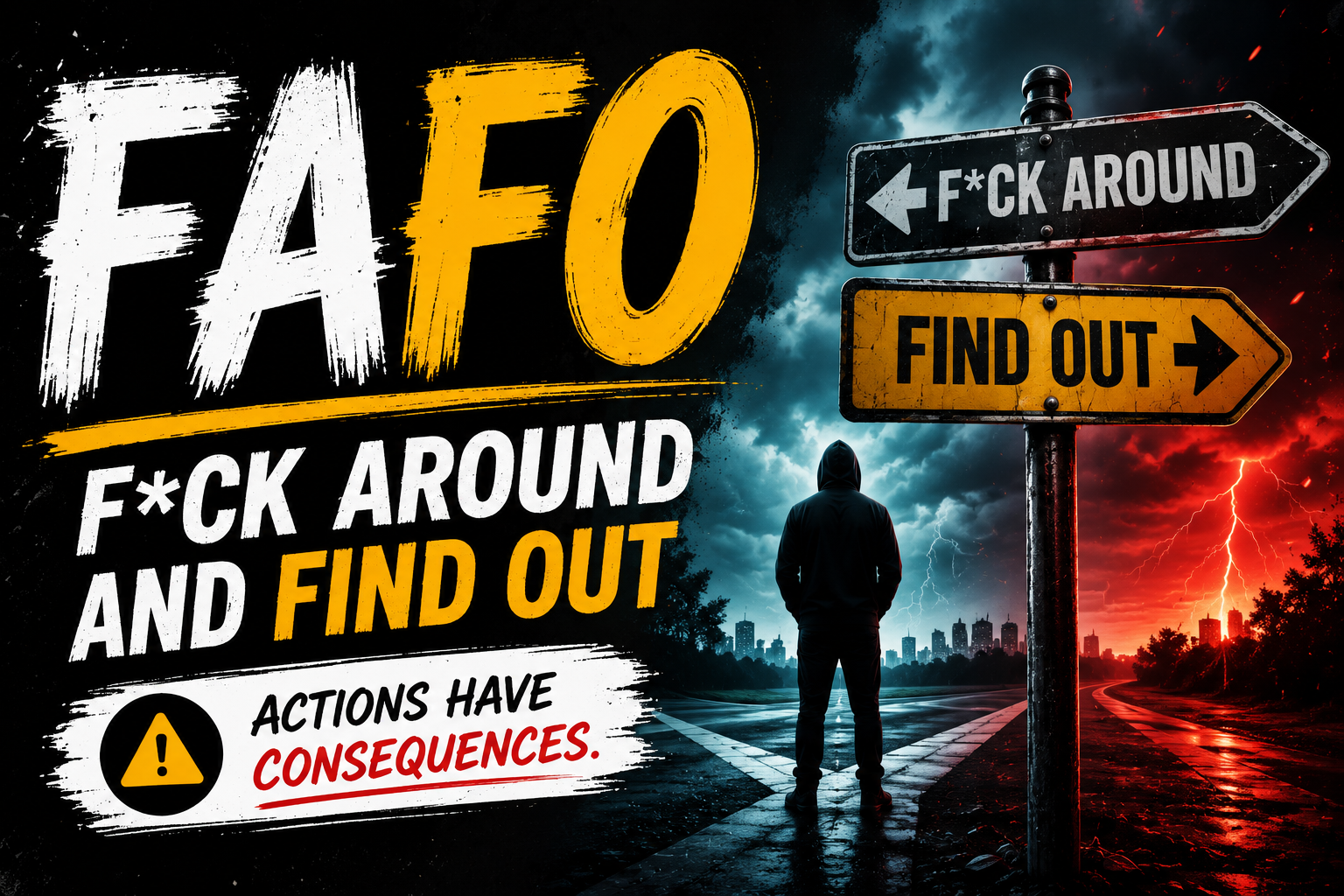
What Does FAFO Mean?
You’ve probably seen it in a comment section, a text thread, or scrawled under a video where someone clearly regrets their choices. FAFO stands for “f*** around and find out.” At its core, it’s a blunt way of saying that actions have consequences, and you’re about to feel them.
It works as more than a phrase. People use it as a noun (“that was a total FAFO moment”), a verb (“he’s about to FAFO”), an adjective, or just a standalone reaction dropped as a hashtag. Some say it as one word, “faff-oh.” Others spell it out letter by letter. Neither way is wrong. The meaning stays the same either way: you took a risk, and now you get to live with what happens next.
Where Did FAFO Come From?
Early Origins
The full phrase “f*** around and find out” is older than most people realize. Writers at the Washington Post and Mental Floss have traced printed use of the saying back to roughly 2007, with linguistic roots in African American Vernacular English. Long before it hit your feed, it also had a life on shop walls and biker culture, where it worked as a flat warning against testing the wrong person.
So this wasn’t invented online. The internet just gave it a shortcut and a much bigger stage.
How It Moved Into Mainstream Slang
The acronym version took off through memes. Know Your Meme traces one of the earliest visual versions to a 2019 Reddit post parodying the Gadsden flag, swapping the coiled snake for a crocodile saying the phrase outright. That planted a template other creators kept remixing.
The real explosion came in September 2022, when TikTok creator Roger Skaer posted a whiteboard chart plotting “f*** around” against “find out” on two axes, with a simple diagonal line connecting them. It was low effort and instantly quotable, and it racked up nearly four million views within its first two days online. From there, the format got remixed endlessly, stamped onto political commentary, sports collapses, and market crashes alike.
How People Use FAFO Today
On Social Media
Scroll through TikTok, X, or Instagram and you’ll catch FAFO doing a lot of different jobs. Sometimes it’s a joke tacked onto a clip of someone getting exactly what they had coming. Sometimes it’s dead serious. A Minnesota meteorologist used it on X to warn that cuts to weather-service funding could cost lives, framing it as no joke at all.
In Everyday Conversation
Off the internet, people use FAFO the same way they’d use “poke the bear” or “play stupid games, win stupid prizes.” It’s a caution before the fact, or an “I told you so” after it. Parents use a softer version of this idea too. There’s even a whole “FAFO parenting” trend, where a parent lets a kid learn a hard lesson firsthand instead of stepping in early, something Kylie Kelce talked about openly on her podcast.
In Political and Cultural Commentary
FAFO has had real staying power in politics since around 2020, when it circulated in online left-leaning spaces as a warning about the consequences of low turnout. It didn’t stay on one side for long. By the 2024 election cycle, it was showing up across the political spectrum, used by officials and commentators alike to signal that consequences were coming, whichever direction you voted. Philadelphia’s district attorney used a censored version of it to caution against election interference, and it kept surfacing through 2025 in commentary about policy fallout.
Is FAFO Rude or Offensive?
Playful vs. Genuine Warning
Here’s where FAFO gets tricky. The same four letters can read as a lighthearted jab between friends or as something closer to a threat, and the difference usually comes down to who’s saying it and why. Said between people who already like each other, it often lands as teasing. Said in a heated argument, it reads as a challenge, and sometimes an intimidating one. There have been documented cases of FAFO used in actual threats, including workplace disputes reported by news outlets.
Context Matters
A journalism lecturer quoted by TODAY described FAFO as an all-purpose taunt, useful either as a warning before something happens or as a jab afterward. That flexibility is exactly why you can’t judge the phrase in isolation. Tone, relationship, and setting decide whether it’s funny or hostile. It’s also worth knowing the phrase has been claimed at times by extremist groups as a rallying slogan, which is one more reason context and company matter before you use it casually.
How to Use FAFO in a Sentence
Once you understand the tone-dependence, using it well gets easier. A few natural examples:
- “I told her not to touch the stove, but she FAFO’d anyway.”
- “That company ignored every warning sign. Total FAFO situation.”
- “Don’t test me on this one. FAFO.”
When Not to Use It
Skip it in professional emails, formal writing, or any setting where you don’t already know your audience well. It’s built for casual speech and internet shorthand, not a client meeting. Using it with someone who doesn’t know the phrase can also just confuse them, or worse, come across as aggressive when you meant it as a joke.
FAFO vs. Similar Phrases
FAFO isn’t a new idea dressed in new letters. It sits alongside older warnings like “mess with the bull, get the horns” or “stir the pot and get burned.” What makes FAFO different is the delivery. It’s shorter, sharper, and built for a screen, which is exactly why it spread the way older idioms never could.
Frequently Asked Questions
Who started saying FAFO? No single person coined it. The underlying phrase has roots in AAVE and biker culture going back decades, while the acronym meme format took off through a viral 2019 Reddit post and a 2022 TikTok chart that made it recognizable at a glance.
What does FAFO mean in a text message? Same meaning as everywhere else: a warning or a callback to the fact that someone’s actions caught up with them. In texts it’s often shorthand for “I warned you” or “don’t push your luck.”
Is FAFO a threat? It can be. Whether it’s a joke or an actual threat depends entirely on tone and context. It has shown up in real confrontations and even documented workplace threats, so don’t assume it always lands as harmless.
How do you spell out FAFO? Most commonly F-A-F-O, standing for “f*** around and find out.” You’ll occasionally see FAAFO as a variant spelling with an extra A.
Final Thoughts on FAFO
FAFO has stuck around because it says a lot in four letters: take the risk if you want, but the consequences are still coming. Whether you hear it as a joke, a warning, or something sharper depends entirely on who’s saying it and why. Understanding that context is really the whole trick to using it, or reading it, correctly.
