

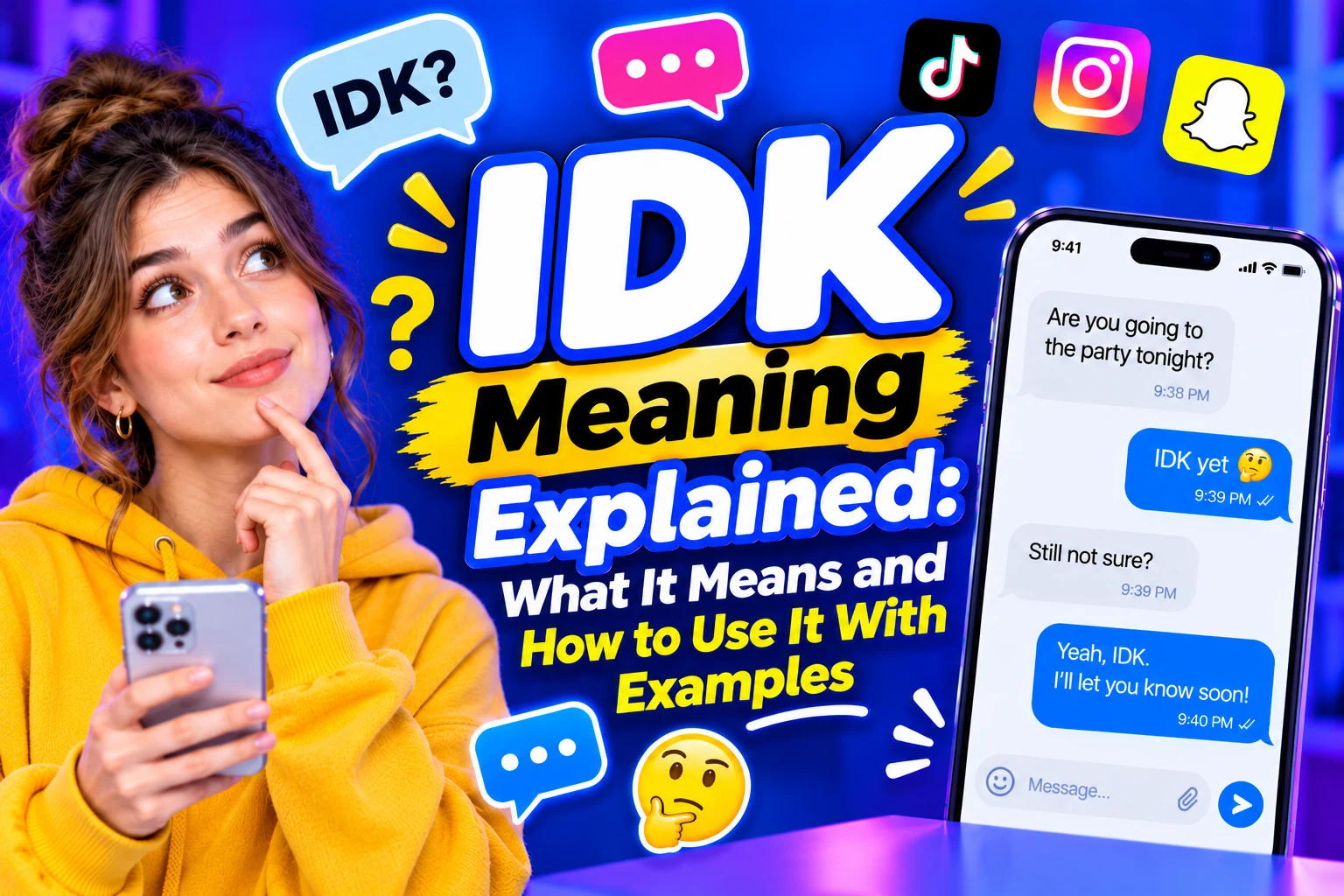
IDK means “I don’t know.” It is an informal abbreviation used in texts and online messages when someone lacks information or feels unsure. For example, “IDK where I left my headphones” means the speaker cannot remember their location.
You can use IDK as a complete reply or include it in a longer message. The definition stays simple, but the wording around it affects how helpful or friendly the response feels.
What Does IDK Stand For?
IDK takes its letters from three words:
- I means the person speaking.
- D comes from “don’t.”
- K comes from “know.”
The abbreviation already includes the subject and verb. That makes it a complete response to a question.
Question: “Who painted the mural outside the library?”
Answer: “IDK.”
The answer communicates a lack of knowledge. Adding a useful detail can keep the conversation moving: “IDK, but the librarian might know.”
When Do People Use IDK?
People use IDK when they cannot answer a question, explain something, or make a decision yet.
These situations share uncertainty, but they are slightly different. You might lack a fact, feel undecided, or question an idea.
| Situation | Example | What it communicates |
|---|---|---|
| Missing information | “IDK which entrance is open.” | I do not have that detail |
| An unfinished decision | “IDK whether to buy the blue one.” | I have not chosen |
| An unknown explanation | “IDK why the alarm stopped.” | I cannot explain it |
| Doubt about a suggestion | “IDK. That route looks longer.” | I am not convinced |
The final example shows how IDK can introduce hesitation. The speaker has an opinion but remains uncertain about the suggestion.
How to Use IDK in a Sentence
You can generally use IDK where “I don’t know” would fit in an informal message. It can stand alone or introduce further information.
The easiest check is to replace the letters with the full phrase. If the sentence makes sense, the structure probably works.
As a Short Answer
A: “Did Sam bring the speaker?”
B: “IDK. I haven’t seen him.”
This response answers honestly and explains why the information is missing.
A single “IDK” also works, especially during a quick exchange. However, it gives the other person less help.
Before a Question Word
IDK often comes before words such as what, where, when, why, who, and how.
Examples include:
- “IDK what this button does.”
- “IDK when the parcel was delivered.”
- “IDK how she folded that paper crane.”
Each sentence identifies the information the speaker does not have. This is more specific than leaving the abbreviation alone.
Before “If” or “Whether”
Use this structure when an answer or decision remains uncertain.
“IDK if the café accepts reservations.”
“IDK whether I can finish before lunch.”
The first sentence concerns missing information. The second concerns the speaker’s ability to complete something.
A Grammar Point English Learners Should Notice
After “I don’t know,” an embedded question usually follows statement word order. An embedded question is a question placed inside a larger sentence.
This rule still applies when IDK replaces the opening phrase.
| Correct | Incorrect |
|---|---|
| “IDK where the charger is.” | “IDK where is the charger.” |
| “IDK when the lesson starts.” | “IDK when does the lesson start.” |
| “IDK why he left.” | “IDK why did he leave.” |
Compare “Where is the charger?” with “I don’t know where the charger is.” The direct question and embedded question use different word order.
IDK Examples in Everyday Messages
Original conversations make the abbreviation easier to recognize in different situations.
Choosing Something Together
A: “Should we order noodles or sandwiches?”
B: “IDK. What did you have yesterday?”
The second person has not decided. Their question helps narrow down the choice.
Asking About a Class
A: “Are we supposed to print the worksheet?”
B: “IDK. I’ll check the class announcement.”
The reply combines uncertainty with a practical next step.
Discussing a Photo
A: “Which beach is this?”
B: “IDK. My cousin sent the picture.”
Here, the speaker explains why they cannot identify the location.
Reacting With Surprise
A: “How did you find that tiny earring?”
B: “IDK how I spotted it under the chair.”
The reply expresses surprise at something the speaker actually did. They know what happened but cannot fully explain it.
Is IDK Rude or Dismissive?
IDK is not automatically rude. It can be a neutral answer, though a bare reply may feel abrupt in some conversations.
Imagine asking a friend about a recipe. “IDK” may be enough if neither of you knows the answer.
Now imagine asking a teammate about a task they manage. “IDK” alone may feel unhelpful because you expected them to investigate.
I suggest adding what you can do next when the question needs action. “I don’t know yet, but I’ll check” gives the reader a clearer response.
Does IDK Mean “I Don’t Care”?
No. IDK expresses missing knowledge or uncertainty. IDC means “I don’t care.”
These messages can create very different impressions:
“IDK which seats are available.”
“IDC which seats we choose.”
The first speaker needs information. The second has no strong preference, although the wording may sound blunt.
If you mean that either choice is acceptable, “Either works for me” is often friendlier than IDC.
IDK vs. Similar Abbreviations
Several short forms appear beside IDK in casual conversations. They serve different purposes.
| Abbreviation | Meaning | Example |
|---|---|---|
| IDK | I don’t know | “IDK who booked the room.” |
| IDC | I don’t care | “IDC about the score.” |
| IKR | I know, right? | “IKR? That ending surprised me too.” |
| TBH | To be honest | “TBH, I preferred the earlier version.” |
IDK and IKR are especially easy to confuse visually. However, one expresses uncertainty while the other usually expresses agreement.
Learn each phrase through a sentence rather than memorizing the letters alone.
What Does IDK Mean on Social Media?
In an ordinary comment or message, IDK still means “I don’t know.” Moving from a text conversation to Instagram or Discord does not automatically change the expansion.
A caption such as “IDK why this made me laugh” expresses an unexplained reaction. A comment saying “IDK the artist’s name” identifies missing information.
The surrounding sentence tells you what is unknown. There is usually no need to search for a separate platform-specific definition.
Should You Write IDK or idk?
Both uppercase IDK and lowercase idk appear in informal writing. Lowercase letters do not change the basic meaning.
Choose the style that suits the exchange. Friends may use lowercase throughout, while someone else may prefer uppercase abbreviations.
Avoid reading too much into capitalization alone. “IDK” does not prove anger, and “idk” does not prove indifference.
Is IDK Suitable for Work or School?
IDK belongs to informal communication. It can fit a relaxed team chat when everyone understands the abbreviation.
For a client email, assignment, or formal report, write the full phrase or choose a more precise alternative.
Instead of “IDK the final cost,” write, “The final cost has not been confirmed.” That version explains the situation more clearly.
Better Alternatives When You Need More Detail
The right replacement depends on what you mean.
- “I’m not sure.” You have some information but lack confidence.
- “I haven’t decided yet.” You are still choosing.
- “I don’t have that information.” A specific fact is unavailable.
- “I’ll check and get back to you.” You intend to investigate.
Only promise a follow-up when you plan to provide one. A clear, honest answer is more useful than an empty reassurance.
How to Reply When Someone Says IDK
If the person lacks information, suggest a place to check: “Could it be in the booking email?”
When they are undecided, offer a smaller choice: “Would Saturday or Sunday suit you better?”
If their answer leaves something important unresolved, ask specifically: “Who could confirm the deadline?” This keeps the exchange focused.
Frequently Asked Questions
Q: Is IDK slang or an abbreviation?
It is an informal abbreviation commonly grouped with texting slang. Its letters represent “I don’t know.”
Q: Can IDK mean “I don’t remember”?
It can fit a situation involving forgotten information. However, “I don’t remember” explains that particular problem more precisely.
Q: Is “I IDK” correct?
Usually, no. The abbreviation already contains “I,” so adding another one repeats the subject.
Q: Can I use IDK in an essay?
Use standard wording in an essay unless you are quoting or discussing the abbreviation itself.
Q: Does IDK mean someone wants to stop talking?
The abbreviation alone cannot establish that. They may simply lack the answer or need time to decide.
Conclusion
IDK is a convenient way to say “I don’t know” in casual messages. Use it alone for a quick answer or add details when the conversation needs more help.
For formal writing or important questions, choose wording that explains exactly what remains uncertain.
