


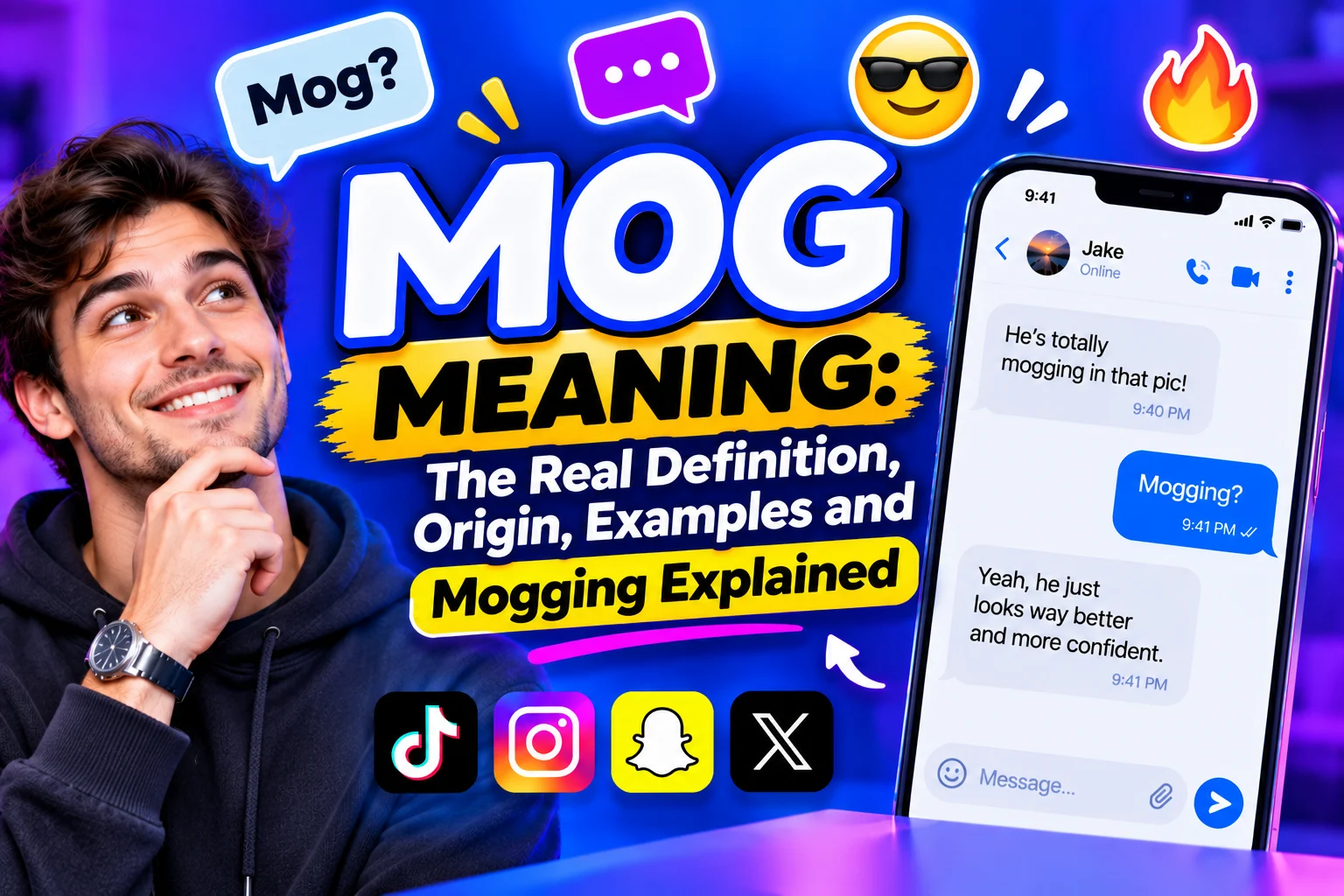
Mog means to outshine or outclass someone, usually through appearance. Someone might mog another person by looking taller, dressing better, or standing out in a group photo. The word can also describe someone performing much better than others.
You may see comments like “He mogged everyone” or “She’s mogging without trying.” Both suggest that someone stands out when compared with the people around them.
However, the message can sound admiring, playful, or insulting. Before using it yourself, it helps to understand what people are comparing.
What Does Mog Mean?
In everyday internet slang, mog means to make someone else seem less impressive by comparison. Appearance is the usual focus, especially height, facial features, clothing, or build.
Imagine three friends taking a picture before a party. One arrives wearing a perfectly fitted suit. Someone comments, “You’re mogging the whole group.” They mean that person looks especially impressive beside everyone else.
The comparison does not always involve effort. Someone can receive the label simply by standing beside another person. They may have no intention of competing.
What Is Mogging?
Mogging is the act of outshining another person. Meanwhile, getting mogged means being the person who appears less impressive in that comparison.
These forms describe the same situation from different sides:
| Term | Meaning | Example |
|---|---|---|
| Mog | Outshine someone | “That jacket makes you mog everyone.” |
| Mogs | Outshines someone | “She mogs us in every photo.” |
| Mogged | Outshone someone or was outshone | “My brother mogged me at the wedding.” |
| Mogging | Currently outshining someone | “You’re mogging the entire lineup.” |
Notice the doubled g in “mogged” and “mogging.” Those are the usual spellings.
A person might also say, “I got mogged.” Here, they are admitting that somebody else stood out more.
Where Did Mog Come From?
Mog is generally traced to AMOG, meaning “Alpha Male of the Group.” That older expression appeared in online communities discussing male status, attraction, and dominance.
Over time, the shortened form became a verb. Merriam-Webster records “mog” appearing in male-focused forums by 2016. It later became associated with looksmaxxing discussions about improving physical appearance.
That background explains the word’s competitive tone. However, knowing its history does not tell you exactly what every speaker intends. A friend joking about wedding outfits may be using it casually.
Is Mog an Acronym?
Mog itself usually works as a word, rather than an acronym. Its proposed root, AMOG, is the acronym.
This distinction helps when someone asks what each letter represents. In an ordinary comment such as “You mog,” the writer is using a verb. They are not spelling out a separate three-word phrase.
Writing “MOG” in capitals does not automatically change that meaning. People often capitalize slang for emphasis, especially in excited comments.
How People Use Mog Online
Mog appears in appearance comparisons, reaction comments, and jokes about someone standing out. Broader uses can involve sporting ability or another performance. Dictionary.com includes both appearance and performance in its definition.
In Photos and Videos
A group picture gives viewers an easy comparison. Someone may focus on one person’s outfit, posture, or overall presence.
For example:
“Everyone wore casual clothes and Zara arrived looking ready for a magazine cover. She mogged us.”
Here, the speaker is praising Zara while making a joke about the rest of the group.
Between Friends
Friends may use the word without taking the comparison seriously.
“I spent an hour getting ready. You showed up in a plain sweater and still mogged me.”
The line sounds like playful admiration. It suggests that the other person looked good without much effort.
Beyond Appearance
A speaker can extend the word to an obvious difference in ability.
“We practiced all week. Our little cousin joined the game and mogged everyone.”
In this example, the cousin performed better. Nothing in the sentence suggests a comparison of faces or clothing.
Is Mogging a Compliment or an Insult?
Mogging can be either, depending on who receives the message. Praising one person may also put someone else down.
“You’re mogging today” can sound like a compliment about someone’s appearance. “You got mogged badly” directs attention toward the person being compared unfavorably.
Consider these differences:
| Message | Likely tone |
|---|---|
| “That haircut has you mogging.” | Admiring |
| “My dad mogged me in our holiday photo.” | Self-directed humor |
| “You could never mog her.” | Dismissive |
| “Why are you ranking everyone?” | Objection to the comparison |
A joke shared between close friends may feel different when posted beneath a stranger’s picture. The audience matters as much as the wording.
Does Mogging Always Mean Someone Is Better Looking?
No. Appearance is central to many uses, but the word can describe other comparisons too.
Even within appearance discussions, people may focus on different things. One comment might praise someone’s outfit. Another might refer to their height or hairstyle.
Also, a mogging comment expresses someone’s judgment. It does not establish an objective ranking. People disagree about attractiveness, fashion, and what makes somebody stand out.
Common Mogging Terms Explained
Some online communities attach another word to “mogging” to identify the comparison. You do not need to memorize these expressions to understand ordinary comments.
| Expression | What the comparison concerns |
|---|---|
| Heightmogging | Being noticeably taller |
| Hairmogging | Having hair considered more impressive |
| Jawmogging | Having a jawline considered more defined |
| Framemogging | Having a larger or broader body frame |
These are informal labels. They describe the feature a commenter has chosen to emphasize.
Avoid assuming that every use reflects careful analysis. Someone writing “heightmogged” may simply be joking about a noticeable height difference.
Mog vs. Flex: What Is the Difference?
Flexing means showing something off. Mogging means outshining someone through comparison.
A person posting their expensive watch might be flexing. If someone claims that their outfit makes everyone else look underdressed, that is a mogging comparison.
The two can overlap, but intention separates many examples. Flexing usually suggests some display. Someone can supposedly mog others without trying or even noticing.
Examples of Mog in Everyday Chats
The easiest way to understand the word is to follow the situation around it.
Example 1: An Unexpected Outfit
A: “Why did you wear a three-piece suit to dinner?”
B: “I wanted a decent picture.”
A: “Well, you mogged the rest of us.”
The speaker thinks the suit helped their friend stand out.
Example 2: A Family Comparison
A: “My uncle looks younger than me in this picture.”
B: “You got mogged at your own birthday.”
This is teasing about the photograph. Whether it lands well depends on their friendship.
Example 3: A Strong Performance
A: “How did the school debate go?”
B: “Our final speaker mogged everyone.”
Here, the praise concerns speaking ability rather than looks.
How to Reply When Someone Says You Mog
Your reply can match your comfort level. You do not have to continue the ranking or compare yourself with anyone.
If it feels friendly, try:
- “Thanks. The outfit finally worked.”
- “I’ll give the lighting some credit.”
- “That’s the nicest thing you’ve said today.”
If the comparison bothers you, keep your answer clear:
- “You can compliment me without putting them down.”
- “Let’s leave everyone else out of it.”
- “I’m happy with the picture. That’s enough.”
You can also ask, “Do you mean my outfit?” That gives the other person a chance to explain.
When Should You Avoid Using Mog?
Avoid it when someone is already uncomfortable about their appearance. A comparison meant as humor may make them feel watched or judged.
It can also distract from an achievement. Under a graduation picture, praising someone’s hard work may be more appropriate than ranking their looks against their classmates.
For professional messages, use a clearer expression. “Your presentation stood out” communicates praise without requiring the reader to understand slang.
Frequently Asked Questions
Q: What does “you mog me” mean?
It means the speaker thinks you outshine them. They may be referring to your appearance, clothing, or ability.
Q: Can women use mog?
Yes. Although its origins involve male-focused communities, the word can be applied to women too. Read the surrounding conversation to identify the comparison.
Q: Does mogging require deliberate effort?
No. Someone can be described as mogging simply because another person thinks they stand out.
Q: Is mogging the same as bullying?
Not automatically. Friendly teasing differs from repeated humiliation. Using the term to target someone’s appearance can become hurtful.
Q: What does “I got mogged” mean?
It means the speaker felt outshone. The statement may be serious, exaggerated, or completely playful.
Final Thoughts
Mog means to outshine someone, most often through appearance. Mogging describes that comparison, while getting mogged describes being on the receiving end.
Before using it, consider who the joke involves. A little praise can feel good. Turning everyone nearby into a ranking may change the message.
