

IMO Meaning in Text: Complete Guide With Examples and Social Uses
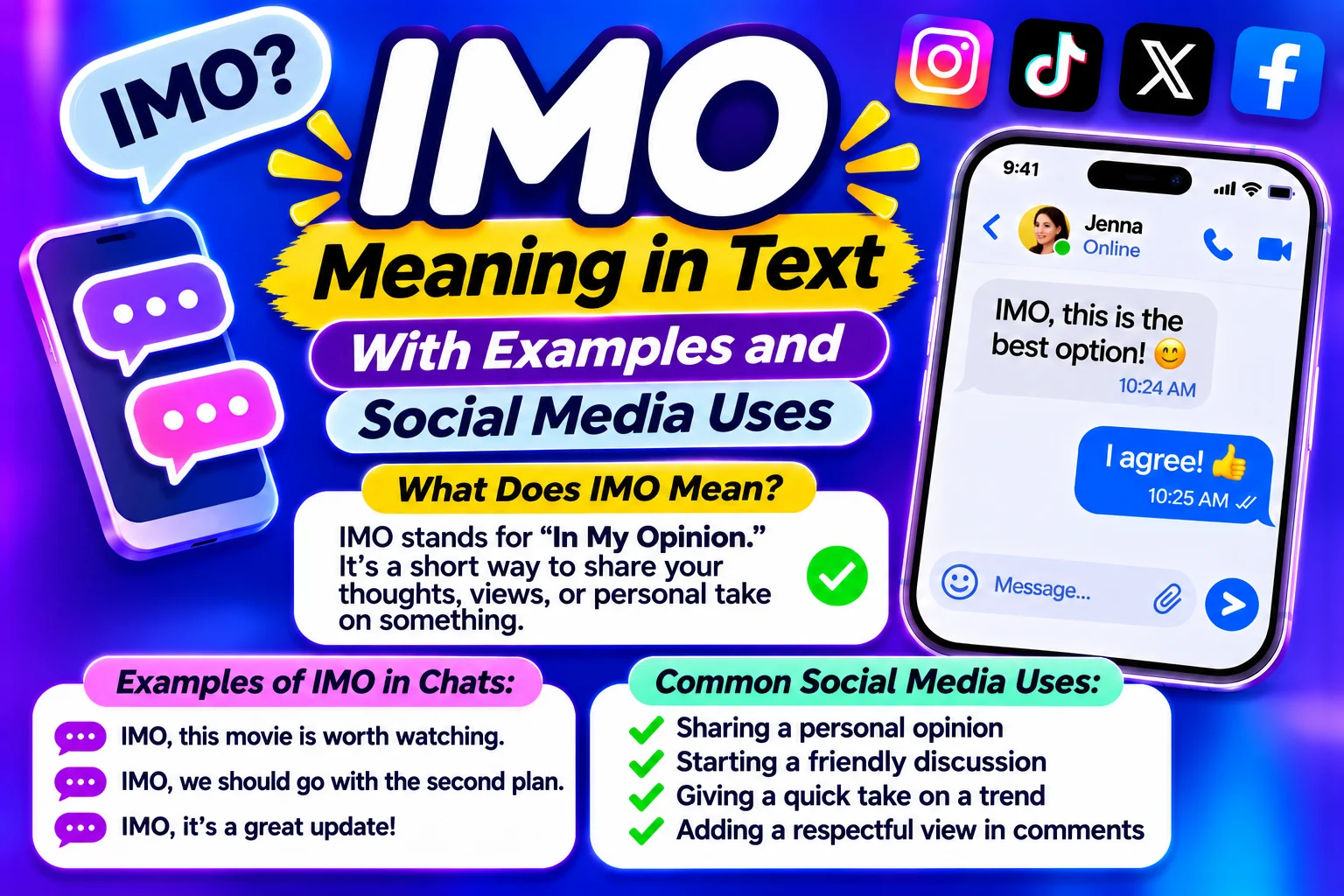
IMO means “in my opinion” in a text. If someone writes, “IMO, the window seat gets too much sun,” they’re giving you their personal take. You might enjoy sitting there for the same reason they’d rather move. The three letters tell you whose judgment you’re reading.
People use IMO when they share a preference, give advice, or disagree in a chat. It can make room for another point of view, especially if you explain why you feel that way. I find it easiest to read IMO as “the way I see it” and then look at the rest of the sentence.
What Does IMO Stand For?
Each letter comes from one word in in my opinion. The I stands for in, the M stands for my, and the O stands for opinion. You can write IMO or imo. Both spellings carry the same meaning in a casual message.
| Text example | What the sender is doing |
|---|---|
| “IMO, the green curtains suit this room.” | Sharing a preference |
| “Book the earlier ferry, IMO. We’ll have time for lunch.” | Making a suggestion and giving a reason |
| “The ending felt rushed, imo.” | Sharing a reaction to a story |
| “IMO, we’re better off repairing it first.” | Giving a view on what to do next |
You can usually replace IMO with the full phrase without changing the main idea. In the ferry example, the sender thinks an earlier trip would work better. The lunch detail explains what they’re considering, so you can decide whether that matters to you too.
Where to Put IMO in a Sentence
At the beginning, IMO tells the reader how to take the words that follow. Write “IMO, the second route is easier to follow.” A comma after the abbreviation gives the opener a natural pause, just as it does in “In my opinion, the second route is easier to follow.”
You can also add it at the end. “The second route is easier to follow, IMO.” Here, the reader sees your view first and gets the reminder that it’s your personal judgment at the end. In a quick chat, you may see the comma left out.
One opinion phrase is usually enough. “IMO, I think we should start again” uses two phrases to introduce the same view. “IMO, we should start again” keeps the message short. “I think we should start again” works just as well if you want to write it out.
How People Use IMO in Real Chats
Helping a Friend Make a Choice
Sana: “Which photo should I frame for the hallway?”
Eli: “IMO, the one at the lake. You can see everyone’s face in it.”
Sana: “Good point. I’ll get that one printed.”
Eli gives a preference and explains it. The reason helps Sana look at both photos again with something specific in mind. If she cares more about the colors, she can still choose the other one.
Disagreeing Without Turning It Into an Argument
Rosa: “I’d put all the announcements at the start of the meeting.”
Cal: “IMO, we should put the longer ones at the end. People only have twenty minutes for the main discussion.”
Rosa: “That makes sense. Let’s move the club updates.”
Cal uses IMO to signal that he sees the plan differently. His reason keeps the reply focused on the time available. If he wrote “IMO, that’s a terrible idea,” the same abbreviation would still leave the sentence sounding harsh.
Giving Feedback Someone Can Use
Nia: “Does this opening make sense if you’ve never played the game?”
Sam: “IMO, it needs one line explaining why the town is empty.”
Nia: “I can add that before the first scene.”
Sam gives Nia one change to consider. That works better than a broad comment like “IMO, it needs work.” When someone asks for feedback, name the part that confused you and explain what would help.
What Does IMO Mean on Social Media?
The meaning stays “in my opinion” in a caption, comment, or direct message. On Instagram, someone might write “IMO, this room looks better in the evening light.” On TikTok, a viewer might say “The first recipe looks easier to make, imo.” Both comments give a personal view of what’s on screen.
In a WhatsApp group or Discord chat, IMO often comes up when people are deciding what to do. For example, “IMO, let’s finish one level before switching games” gives the group a plan to consider. If the chat moves quickly, replying to the original message helps everyone see which suggestion you mean.
If someone adds IMO to a strong public comment, read the rest before deciding how it sounds. “IMO, the original version had a clearer ending” gives people a point to discuss. A jab at the person who posted it can still feel personal, even with the abbreviation in front.
IMO vs. IMHO and “I Think”
IMHO most commonly means “in my humble opinion.” The H adds humble, which can make the phrase sound more modest or a little playful. IMO is the simpler choice when you just want to mark something as your view.
| Expression | When it fits | Example |
|---|---|---|
| IMO | A quick personal take in a chat | “IMO, the smaller bag is easier to carry.” |
| IMHO | An opinion you want to frame modestly or playfully | “IMHO, every good picnic needs brownies.” |
| I think | A natural phrase in speech or writing | “I think the floor plan leaves enough room for a desk.” |
| I’d suggest | A recommendation someone can act on | “I’d suggest moving the speaker closer to the front.” |
When Should You Spell It Out?
IMO fits a casual chat where the reader knows your shorthand. In a client email, “I’d recommend the shorter version because it gets to the price sooner” gives the reader a clear recommendation and a reason. In a school assignment, a sentence like “The final scene suggests that the brother already knew” gives you a point you can support with details from the text.
It also helps to separate a preference from a detail you can check. “IMO, the nine o’clock showing is a better choice” expresses a preference. “The film starts at nine” gives a time. If you’re still checking the schedule, “I think it starts at nine. I’ll check the tickets” tells the group you’re unsure.
How to Reply When Someone Uses IMO
Reply to the view they shared. If you agree, you can add your own reason. After “IMO, the market is easier to get to by train,” you might answer, “Same. We can walk there from the station.” That gives the group another detail to use.
If you see it differently, say what matters to you. “I’d rather drive since we’ll be carrying boxes” keeps the discussion on the plan. If someone’s opinion is too broad to act on, ask a short question like “Which part felt too long?”
FAQs
Q: Can IMO mean something besides “in my opinion”?
Yes. In shipping, IMO can stand for the International Maritime Organization, a United Nations agency that deals with shipping safety and pollution from ships. A message about shipping rules points to the organization.
Q: Does IMO mean the person is unsure?
They can be certain of their view. “IMO, that was easily her best performance” expresses a strong opinion.
Q: Can I ask someone “IMO?”
Use “What do you think?” if you want their opinion. The “my” in IMO refers to the person giving the view.
Q: Do I need to write IMO in capital letters?
Either IMO or imo works in a casual chat. Use whichever fits the rest of your message.
Final Thoughts
Use IMO when you want to share a personal take in a text or comment. A short reason can help someone understand why you feel that way. When you receive it, answer the suggestion or opinion that comes with it.
