

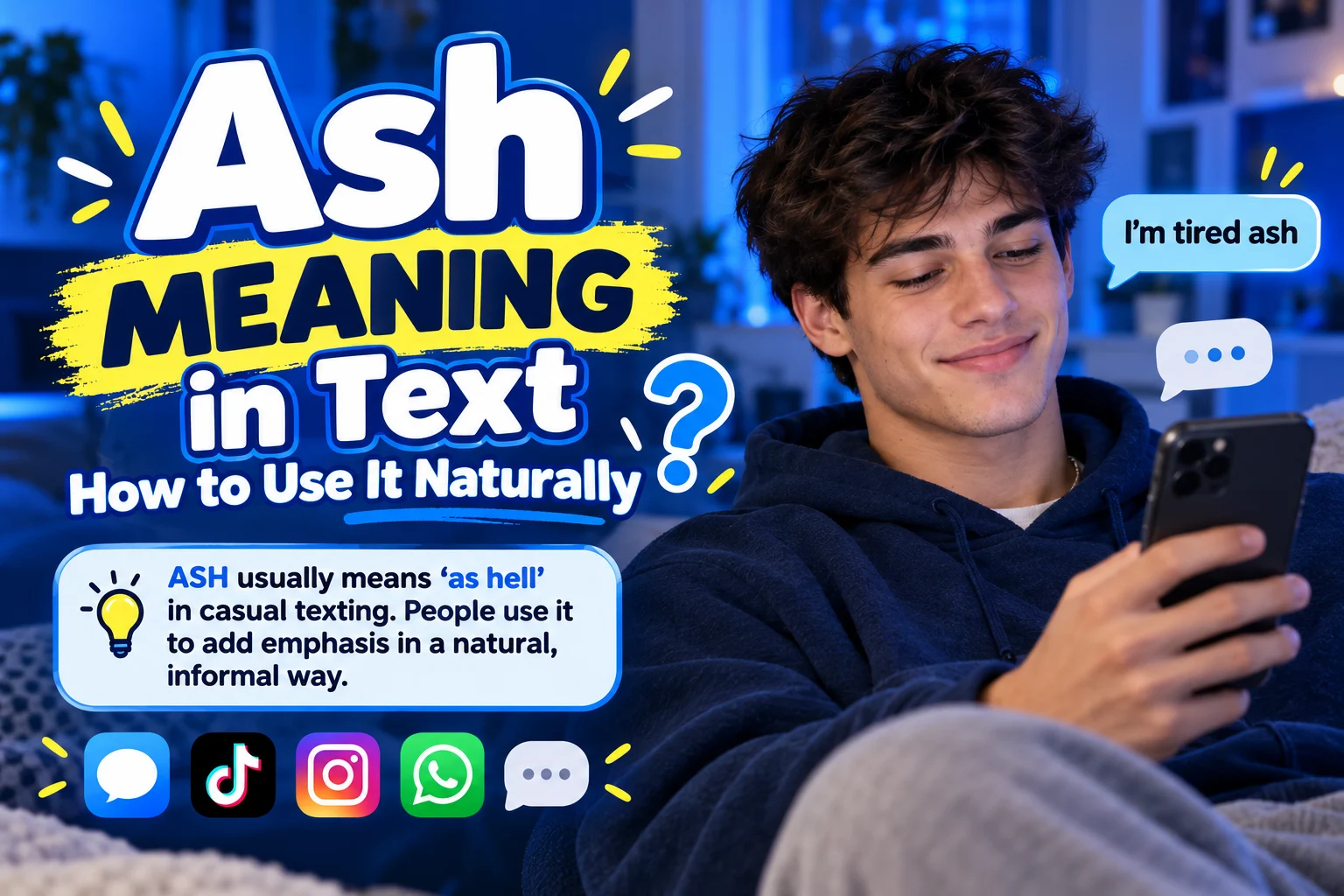
“I’m hungry ash” can look confusing when you first read it. The sentence has nothing to do with a fireplace. The sender is using a short slang expression to say they feel very hungry.
In texting, “ash” can mean “as hell.” It adds emphasis to the word before it, much like “really” or “extremely.” Knowing where it appears in a sentence helps you recognize this meaning.
What Does Ash Mean in Text?
The ash meaning in text is “as hell” when someone uses it after a describing word. For example, “cold ash” means “extremely cold.”
Wiktionary records “ash” as internet and texting shorthand for “as hell” or “as heck.” Your reference also explains its use for adding emphasis.
You should still read the sentence before choosing that definition. “Ash called earlier” probably refers to a person, while “This room is cold ash” uses slang.
| Message | Meaning in ordinary English |
|---|---|
| “I’m hungry ash.” | I’m extremely hungry. |
| “That queue was long ash.” | That queue was very long. |
| “Your puppy is cute ash.” | Your puppy is really cute. |
| “This chair is uncomfortable ash.” | This chair is extremely uncomfortable. |
How Does Ash Work in a Sentence?
Ash strengthens a description rather than introducing a separate idea. The useful pattern is describing word + ash.
For example, “The bus was crowded ash” emphasizes how crowded it felt. Collins explains that the full expression “as hell” follows adjectives or some adverbs to add emphasis.
When you replace ash with “very,” move “very” before the description. “Crowded ash” becomes “very crowded,” rather than “crowded very.”
Where Should You Put Ash?
Place it after the word you want to strengthen. “I’m sleepy ash” follows the same order as “I’m sleepy as hell.”
You would not normally write “I’m ash sleepy” for this meaning. That order makes the intended expression harder to recognize.
You can add more information afterward. “I’m sleepy ash, so I’m heading home” explains both the feeling and the next action.
Why Do People Use Ash?
Ash offers a short way to make a reaction stronger. A sender can express more intensity without writing the full phrase.
Compare “That lift is slow” with “That lift is slow ash.” The second version places greater emphasis on the complaint.
However, you do not need it in every message. Use it when the stronger wording reflects what you want to say.
Examples of Ash in Everyday Chats
The word before ash gives you the main meaning. That word might describe a feeling, an object, or something that happened.
These examples show different uses:
- “My hands are cold ash after that walk.”
- “This puzzle is hard ash.”
- “The apartment looks clean ash now.”
- “That surprise entrance was awkward ash.”
- “Your little brother is quick ash.”
Each sentence adds emphasis, but the overall reaction changes. A positive description stays positive, while a complaint stays a complaint.
When You Feel Hungry or Tired
Friend: “Should we order something?”
You: “Yes, I’m hungry ash.”
Friend: “What do you feel like eating?”
Here, ash communicates strong hunger. It does not introduce a hidden request beyond what the conversation already suggests.
When You React to Something Funny
Friend: “Watch the ending of this clip.”
You: “That last reaction was funny ash.”
The reply means the reaction was very funny. You are strengthening the description rather than giving ash an independent meaning.
Is Ash Positive or Negative?
Ash can appear in positive and negative statements. It increases emphasis without deciding whether the message expresses approval or frustration.
“Helpful ash” can praise someone. “Annoying ash” can criticize something. “Nervous ash” describes a strong feeling.
Read the description first, then consider who or what it concerns. That gives you more information than the slang alone.
Ash Meaning on TikTok and Instagram
In a TikTok or Instagram comment, ash can serve the same purpose as in a private message. It strengthens the description before it.
For example, “This transition is smooth ash” praises the editing. “That explanation was confusing ash” expresses difficulty understanding it.
The platform does not create a different definition. A caption, comment, or DM still needs to make sense within its own sentence.
What Does Ash Mean From a Guy or Girl?
The sender’s gender does not change this slang meaning. “Busy ash” describes being very busy regardless of who writes it.
Likewise, “You look good ash” is a strong compliment. Whether it is friendly or flirty depends on the relationship and surrounding conversation.
You cannot confirm romantic interest from ash alone. The person’s actual words and behaviour give you a fuller picture.
Is Ash Rude or a Swear Word?
The slang expands to “as hell,” so some readers may consider it mild profanity. Others may see it as ordinary casual language.
Shortening the phrase does not guarantee that everyone finds it appropriate. Your audience still matters.
My advice is to use “really” or “extremely” when you are unsure. You can keep the emphasis without depending on slang the reader might dislike.
Can Ash Mean Something Else?
Yes, ash already has ordinary meanings unrelated to texting slang. It can refer to material left after burning or a type of tree.
Ash can also be a name or nickname. Capital letters may provide a clue, but people do not always capitalize names in messages.
Compare these examples:
| Sentence | Meaning of ash |
|---|---|
| “Sweep the ash from the fireplace.” | Material remaining after burning |
| “The table is made from ash.” | A type of wood |
| “Ask Ash about the booking.” | A person’s name |
| “That booking fee is high ash.” | Slang adding emphasis |
Is Ash Always an Abbreviation?
No, you should not treat every appearance as shorthand. The literal word and personal name remain valid possibilities.
For the slang interpretation, try expanding it to “as hell.” If the sentence still makes sense, you have a useful clue.
“I’m restless as hell” works as an expansion. “Please call as hell tomorrow” does not, so “Ash” probably means something else there.
How Should You Reply When Someone Uses Ash?
Respond to the message’s meaning rather than the unfamiliar spelling. Someone saying they are hungry may simply want to discuss food.
A compliment can receive a simple thank-you. A complaint may invite a question or an offer to help.
| Message you receive | A natural reply |
|---|---|
| “I’m hungry ash.” | “Want me to order lunch?” |
| “Your drawing is detailed ash.” | “Thank you. It took a while.” |
| “This room is loud ash.” | “Let’s find somewhere quieter.” |
| “I’m nervous ash about tomorrow.” | “Want to talk through what’s worrying you?” |
| “That ending was strange ash.” | “I didn’t expect it either.” |
How to Use Ash Without Forcing It
Start with a sentence you would genuinely send. Then decide whether you want stronger emphasis on one description.
For example, “This bag is heavy” can become “This bag is heavy ash.” The meaning remains clear because the basic sentence already works.
Avoid adding it repeatedly just to sound current. One suitable use reads more naturally than placing it after every adjective.
When Plain English Works Better
Use ordinary wording in client emails, assignments, and conversations where clarity matters most. The reader may not recognize this particular shorthand.
For example, “The file is extremely large” gives a clear explanation. “The file is large ash” creates an unnecessarily casual tone.
You can also be more specific. “The file is 4 GB” tells the reader more than either version.
Common Mistakes With Ash
One mistake is reading ash as a complete reply meaning “yes,” “whatever,” or agreement. Those meanings are not established by the sources checked here.
Another is assuming the word always expresses anger. The description before it determines what feeling or judgment receives emphasis.
Keep these checks in mind:
- Look for a describing word before ash.
- Try replacing the expression with “really” or “extremely.”
- Consider whether Ash could be someone’s name.
- Ask the sender if the sentence remains unclear.
Frequently Asked Questions
What does ash mean in texting?
Ash can mean “as hell,” adding emphasis to the description before it.
What does hungry ash mean?
“Hungry ash” means very or extremely hungry.
Does ash mean angry?
No, ash does not automatically mean angry; it strengthens the description used with it.
Can ash be a compliment?
Yes, a phrase such as “creative ash” can express strong praise.
Can I use ash in professional writing?
Clearer alternatives such as “very,” “really,” or “extremely” usually suit professional writing better.
Is ash always slang?
No, it can also refer to burnt material, a tree, or a person’s name.
